
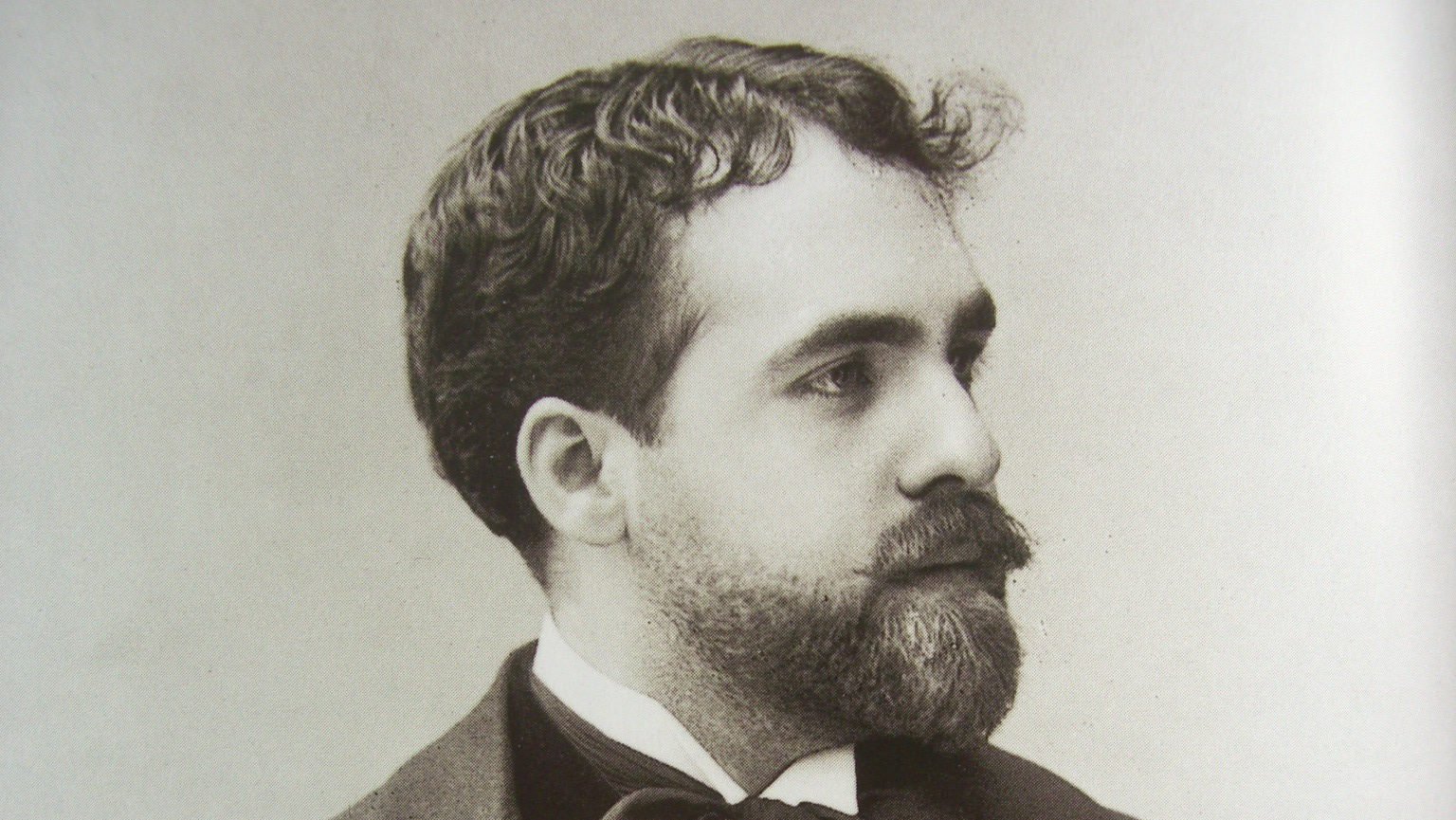
Born in 1874 as the youngest of twelve siblings, 19th-century French composer, conductor and singer Reynaldo Hahn spent most of his life in Paris. He made his public debut at a recital at the age of six and began studying at the Paris Conservatoire at the age of eleven. While prolific overall, Hahn is best known in the world of classical music for his songs, of which he wrote more than a hundred; his first successful song was composed at the age of thirteen. He soon became a part of Paris’s arts scene, known for his memorable recitals:
By 1892 Hahn was something of a celebrity. Contemporary diaries and journals are full of references to the incomparable charm of his performances at musical evenings. Seated at the piano, a cigarette dangling from the corner of his mouth (a trick he employed to demonstrate that it was not necessary to mouth in order to maintain perfect diction), he would lean far back, and mesmerize his audience with keen glances through his long eyelashes.
Hahn is probably more familiar to many for his relationship with famed writer Marcel Proust. The two were introduced in 1894 — at the time, Hahn was considerably more famous than Proust. Hahn and Proust fell in love and began a passionate two-year relationship, travelling together through France. Their travels included a trip along the Brittany coast in September 1895 that later inspired parts of Proust’s novel In Search of Lost Time. (It’s also possible that Hahn suggested the musical motif that plays a significant role in Proust’s novel.)
The two remained friends after their relationship ended, and they inspired each other’s works. Proust’s unfinished novel Jean Santeuil is heavily inspired by their relationship; he wrote to Hahn in 1898, “I mean you to be ever present in my novel, like a god in disguise whom no mortal can recognise.” (While Proust and Hahn’s romantic relationship was known in Parisian inner circles, it was unknown to the larger world until their love letters and correspondence went on display prior to an auction in 2018. Some of their letters and drawings can be seen here.)
Hahn’s career continued to grow at the start of the 1900s, especially as a conductor; he also volunteered for the army and served as a clerk near the frontline during the First World War. After the German occupation of France in 1940, Hahn, who was of Jewish descent, moved to Monaco, where he narrowly avoided an explosion due to a stray shell in Monte Carlo. He returned to Paris in 1945 and was appointed director of the Paris Opera. Hahn passed away in 1947, possibly due to complications from the explosion. He was buried in Père Lachaise Cemetery, near Proust’s grave.
Hahn recorded himself performing both his songs and the works of others, including the below recording of works by 19th century composer Emanuel Chabrier and Hahn’s own works: