
Sunset
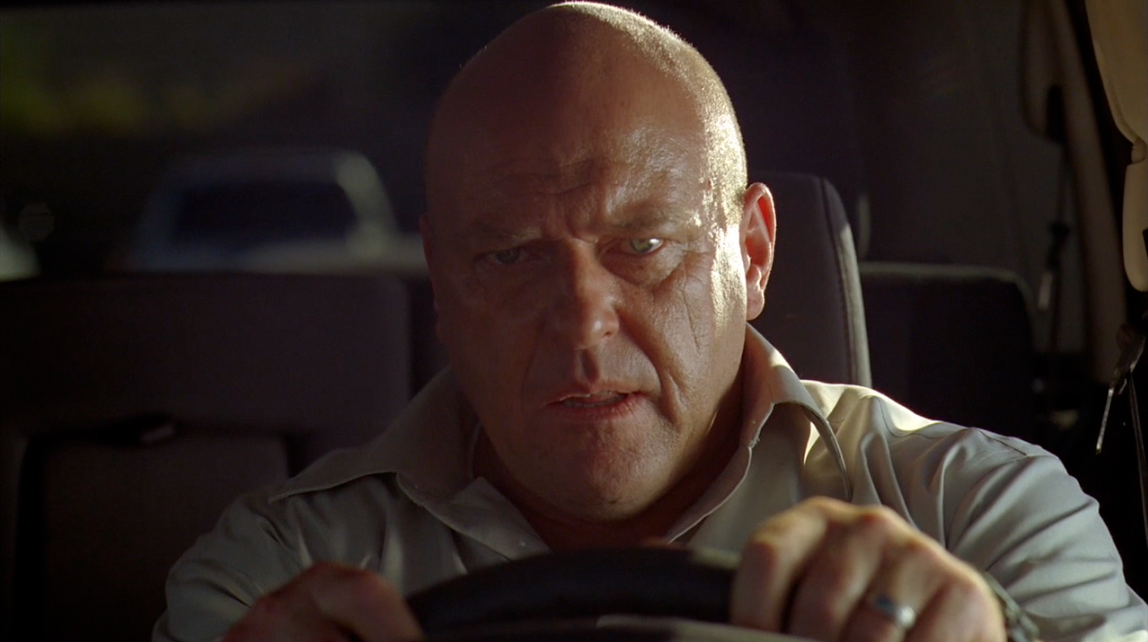
Walter enjoys his first day in the new lab. Unfortunately, Hank’s investigation has led him to Jesse and an RV covered in Walt’s fingerprints.
I should have liked this episode – the plot is well-constructed, we get to see Walt and Jesse work together again, and Dean Norris gives an excellent performance. Unfortunately, when the credits rolled I found myself feeling completely underwhelmed by what I had just witnessed and I think I know why:

Every time these guys appear onscreen, the story comes to an excruciating halt. They aren’t interesting or even essential to the plot – you can always contrive another way to demonstrate Gus’ fraught relationship with the Mexican cartel. I don’t have any evidence for this but it feels like Tuco’s cousins were supposed to be the Breaking Bad version of Anton Chigurh.1 The issue is that Chigurh was extremely compelling to watch – compare the gas station scene in No Country for Old Men with the Mexican criminals sitting around Los Pollos Hermanos scowling at people, and the difference is night and day.
Thankfully, there are moments of quality in this episode, such as the introduction of Walt’s new lab assistant, Gale Boetticher.2 Rewatching the show, I realised that Gale is portrayed differently to the other men we’ve seen so far. Just from his first appearance, we learn that he’s softly-spoken, meticulous and has memorised an entire poem by Walt Whitman. I think this is an example of coding – the use of subtext to say something about a character without necessarily making that statement explicit. I think the writers are hinting that Gale is queer and/or autistic – feel free to disagree with me, but that is the impression I got watching this episode.
I will discuss whether Gale is queer another time, but I want to take a moment to explain why Gale can be interpreted as autistic. For a start, he has intense special interests – he can flawlessly recite When I Heard the Learn’d Astronomer and is using a vacuum pump to make coffee.3 He seems to have difficulty understanding social conventions, since he thought it was appropriate to prepare a CV for your first day at the crystal meth factory. Gale also expresses disdain for the office politics of academia because it takes him away from the laboratory, a controlled environment that he finds captivating.

It’s difficult to say how intentional this all was. Gale was written to be the complete opposite of Jesse, which might have led the writers to pick character traits (such as shyness and a passion for education) that are also associated with autism.4 If it was an intentional decision though, it would add an extra layer of tragedy to the whole situation. Autism and other forms of neurodivergence are not problems to be solved, but they can make it harder to navigate the world. It is easy to imagine Gus manipulating Gale, offering him a job that accommodates his disability without explaining the tremendous risks involved in becoming a meth cook. Sadly, Gale would not be the first disabled person to end up on the wrong side of the criminal justice system and pay a heavy price for it.
Odds and Ends
- The opening teaser with the Mexican criminals has a yellow filter, despite taking place inside the United States. At this point I have to conclude that the colour doesn’t represent Mexico at all – it represents Tuco’s cousins or the cartel.
- It’s a petty complaint but that cop called for back-up before he was murdered – are the Mexican criminals planning on fighting the entire Albuquerque police force!? It doesn’t look like they have enough time to flee the area without being spotted.
- I know I’ve complained about Breaking Bad’s cinematography a lot recently, but I love the sequence where Hank runs through the hospital – the muted colours, frantic editing and muffled sound conveys really well how panic is overwhelming Hank’s senses.

- I think I am in a love-hate relationship with Saul Goodman. In the last review, I complained that he was misogynistic and one-note, but in this episode:
1) He chews Walter out for not having a contingency plan for disposing of the RV, a funny scene that also functions as meta-commentary.
2) After his employee rings Hank and lies about Marie being in an accident, Saul has a sombre look on his face, almost as if he is ashamed of what he has done – it lets the audience wonder if there are other burdens Saul might carry with him…
Spoilers
- Walt tells Skyler that he has been using drug money to pay their household bills for at least six months, making her an accessory after the fact. This revelation probably contributed to Skyler’s decision to pay for Hank’s physical therapy in Kafkaesque (Series 3, Episode 9) – she’s already a criminal, so why not use that money to help her sister and brother-in-law?
One Minute
Furious that he has been tricked, Hank drives to Jesse’s house and beats him unconscious. Suspended from the DEA, Hank is left unarmed just as Tuco’s cousins arrive to murder him.
I had fond memories of this episode and while it is good – the parking lot shoot-out might be the most exhilarating sequence in the entire show – the story feels unfocused and a little unsatisfying. I know I am just an amateur reviewer with no screenwriting experience, but it seems to me that Season 3 has suffered a substantial decline in quality. Walter’s characterisation is strongest when he is faced with an antagonist (be that cancer or a rival dealer) and the writers have removed most of these obstacles. As mentioned earlier, the Mexican criminals have been severely over-developed but this has also taken attention away from Jesse and Skyler, who have more interesting plot-lines we could be exploring.
To illustrate this point, consider the scene where Jesse rejects Walter’s offer of a job in Gus’ laboratory. In the last installment, the RV and all its contents had to be destroyed so Hank couldn’t seize them as evidence. In retaliation, Hank beat Jesse so badly that he lost consciousness – the third time in less than a year that someone has done this to him.5 When Walt visits him in the hospital, Jesse gives voice to all his anguish and unhappiness, blaming Walt for everything he’s suffered since they started cooking together. Aaron Paul gives a powerful performance here, but it is undercut in the very next scene when he agrees to work with Walt again. We could have spent some time examining the fallout from this fight and why Jesse and Walter decide to reconcile – instead we rush past it. This is the opposite of well-paced storytelling.

This review has been quite negative so far, but I want to stress that I really like Hank’s plot-line in this episode. His assault on Jesse is genuinely shocking and the writers make a point of emphasising (through Hank’s conversation with Marie) that his behaviour is not excusable, no matter how much stress he was under. Rewatching the show in 2024, you could make the complaint that Breaking Bad sees police brutality as a problem with individual officers, rather than a structural flaw in the criminal justice system. In his earliest appearances, Hank was a lot rougher with suspects and regularly dehumanised them using bigoted language. That could have built to a more thorough critique of the War on Drugs, but instead we pivot to toxic masculinity as the reason for Hank’s destructive behaviour. That wasn’t necessarily a bad choice as the show produced some very effective and nuanced critiques of patriarchy, but I do lament the road not taken.6

The final thing we need to discuss is Walt’s decision to reject Gale as a lab assistant. Walt tells Gus that he works better with Jesse, but I don’t think we can take this at face value. Putting to one side that Walter is a habitual liar, the writers have also tried to make his motivations more ambiguous – not every decision he makes is about earning money for his family anymore. Offering the assistant job to Jesse could have just been a tactical move to prevent a lawsuit against Hank, but that isn’t the only possible interpretation. Personally, I think Walt cannot handle being surpassed by another person and since Gale is clearly a very talented chemist, that makes him a threat. Jesse isn’t stupid but he is lonely, and Walt can use Jesse’s desperation for approval as a way to control him. For now, they both need this relationship, but it isn’t a relationship of equals – that is something that Walt will not allow to develop.
Odds and Ends
- In the opening flashback, Hector refers to a “chicken man” who he disparages as a “sudaca” – an insult directed at people from South America. This is the first hint we get of Gus’ backstory.
- Skyler visits Walter and asks him to persuade Jesse not to press charges against Hank – he refuses and says that Hank is “not currently” his family. This line is interesting because it implies that Walt sees family as conditional rather than something permanent or based on blood ties. Unfortunately, I don’t think Walt ever expresses this attitude again, which strikes me as shoddy writing.
- Gale quotes Casablanca to Walt, which could be considered a form of autistic echolalia (repeating words and phrases in order to facilitate communication).
- Dean Norris said in a 2013 Vulture interview7 that his favourite scene in Breaking Bad is the discussion with Marie where he admits that “I’m just not the man I thought I was.” Norris empathised with Hank so much in that moment that he struggled to say the lines without crying – they ended up filming Norris sideways-on so they could hide how emotional he was.
- The final shoot-out with Tuco’s cousins is one of the best action sequences I’ve ever seen from a television studio. First, the camera follows Hank out of the store, establishing the geography of the scene. We then stay inside the car with him as he scans for threats, increasing the sense of claustrophobia. The soundtrack ratchets up the tension even more and once the gun-fight actually starts, we can easily discern when someone has been shot and where the bullet penetrated their body. It is a perfectly constructed sequence and even though this is the second time I’ve seen it, I still feared for Hank’s life.

Spoilers
- We learn in Hermanos (Series 4, Episode 8) that Gus was born in Chile and I’m a little disappointed that the writers decided to make yet another of Walter’s antagonists a non-white foreigner. The racial politics of Breaking Bad leave a lot to be desired…
Please use spoiler tags in the comments, as some Avocadians are watching Breaking Bad for the first time
- This episode premiered early in 2010, only three years after No Country for Old Men came out, so the timeline makes sense. ↩︎
- Played by David Costabile. ↩︎
- Gale says that he dislikes bitter flavours, so this could also be considered a coping strategy to deal with his hypersensitive tastebuds. ↩︎
- There is a GQ article from 2021 titled “Singing Bad…” that discusses Gale and the creation of his character, but it has spoilers for the rest of the show. ↩︎
- Emilio, Tuco and now Hank have all beaten Jesse until he is unconscious. ↩︎
- Speaking to Vice in 2013, Gilligan said that he is “agnostic” on whether the War on Drugs is a good thing. That attitude, coupled with the regular use of DEA consultants by the cast and crew, might explain why Breaking Bad did not make more pointed criticisms of the police. ↩︎
- So spoilers for all the remaining seasons. ↩︎
You must be logged in to post a comment.