
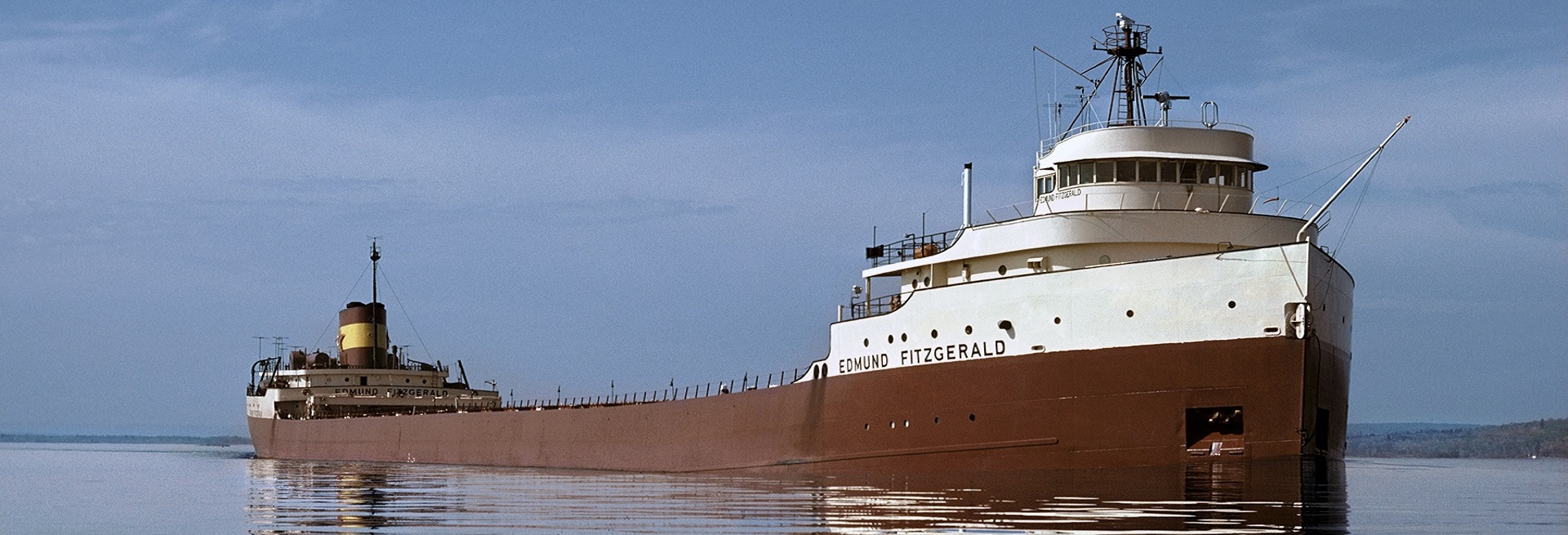
The SS Edmund Fitzgerald was a freighter ship which worked the Great Lakes from her launch in 1958 until she sank with all 29 hands in a storm in Lake Superior on the evening of November 10, 1975. Plenty of ships have gone down in the Great Lakes before and since, but the Edmund Fitzgerald was by far the largest to have ever gone down in those waters, and will likely remain the most famous thanks to the beautiful and haunting song “The Wreck of the Edmund Fitzgerald” released by Gordon Lightfoot the next year.
Around 5:30 pm, Captain McSorely of the Edmund Fitzgerald was in contact with the captain of another ship in the area. “I have a ‘bad list’, I have lost both radars, and am taking heavy seas over the deck in one of the worst seas I have ever been in.” Communications with the US Coast Guard were hampered by the fact that the fierce winds had knocked down several radio antennas at Coast Guard stations.
By late in the afternoon of November 10, sustained winds of over 50 knots (93 km/h; 58 mph) were recorded by ships and observation points across eastern Lake Superior. Arthur M. Anderson logged sustained winds as high as 58 knots (107 km/h; 67 mph) at 4:52 p.m., while waves increased to as high as 25 feet (7.6 m) by 6:00 p.m. Arthur M. Anderson was also struck by 70-to-75-knot (130 to 139 km/h; 81 to 86 mph) gusts and rogue waves as high as 35 feet (11 m).
At approximately 7:10 p.m., when Arthur M. Anderson notified Edmund Fitzgerald of an upbound ship and asked how she was doing, McSorley reported, “We are holding our own.” She was never heard from again. No distress signal was received, and ten minutes later, Arthur M. Anderson lost the ability either to reach Edmund Fitzgerald by radio or to detect her on radar.
Since there were no survivors, we will never know why Captain McSorley never sent a distress signal, or made for safe harbor at Whitefish Bay, which was only about an hour away. Many were shocked – both within the shipping industry and among the general public – that such a massive, modern ship could go down with all hands. It felt like one of those things that simply didn’t happen anymore. But it’s precisely that attitude which leads to complacency. The captain of a different freighter which was out on Lake Superior that day took refuge in Thunder Bay to wait out the storm, and accused Captain McSorley of negligence for failing to do the same.