
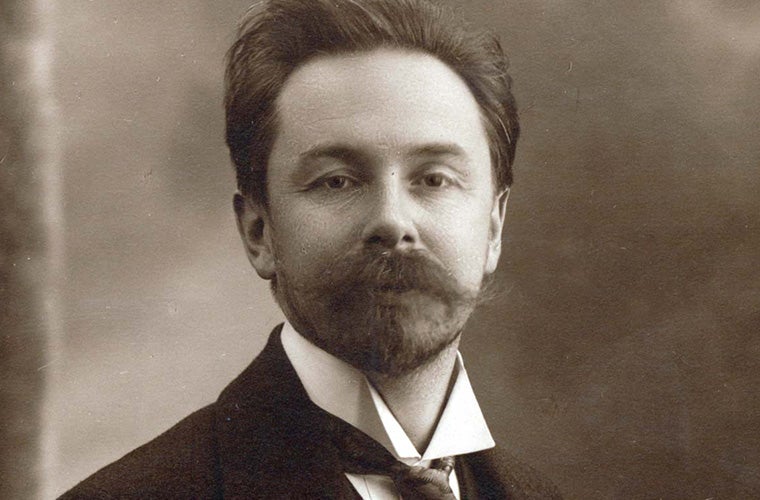
Alexander Scriabin was born in Moscow in 1871, and died there in 1915. He studied piano and composition at the Moscow Conservatory, but graduated with only a degree in piano performance – his composition teacher lost patience with Scriabin because he refused to even attempt to compose a work in any form which didn’t already interest him, and the teacher refused to sign his graduation certificate.
Scriabin made a triumphant debut at the piano in Saint Petersburg in 1894, performing his own works. He was soon offered a contract with a publisher. By 1898 he had performed in Paris and was offered a position on the faculty at his alma mater.
He was deeply interested in mysticism, Russian cosmism, and theosophy, and expressed these interests through his compositions. While he didn’t experience it himself, he was also fascinated by synesthesia, an involuntary condition in which the stimulation of one sense creates a response in another. He developed his own system in which each key of music was associated with a specific color. He left unfinished at his death a work called Mysterium which “would have been a pioneering multimedia performance… a weeklong performance including music, scent, dance, and light in the foothills of the Himalayas that was somehow to bring about the world’s dissolution in bliss.”
Scriabin finished work on The Poem of Ecstasy in 1908, and it premiered in New York City in December of that year. The complete work lasts about 20 minutes, but the final 2:30 can be heard here, performed by the Berlin Philharmonic led by their music director, Kirill Petrenko: