

2024 was a busy year for yours truly, both professionally and otherwise, but I still managed to read 200-ish books because you can’t keep a good bibliomaniac down. I surveyed a pretty decent swath of history, and while the below is hardly comprehensive, it’s a good representative example of what I was reading this – and some volumes that stood out as worthy of particular praise.
10. War Without Mercy: Race and Power in the Pacific War (John W. Dower, 1986)

John Dower’s War Without Mercy (a companion volume to his brilliant Embracing Defeat) is a sociocultural analysis of World War II’s Pacific Theater, examining the ways that the Western Allies and Japan viewed and responded to each other. Historians have long noted the vicious race-hatred that motivated this conflict, rivaling the Nazi-Soviet struggle in the level of atrocities and sheer savagery displayed by both combatants. Dower shows how both sides brought deeply ingrained prejudices to the war: the United States viewed Japan through the lens of “Yellow Peril,” endangering America’s supremacy in the Pacific and threatening to overrun their country with immigrants, and thus upset the world’s racial order; meanwhile, British official’s (despite their longtime alliance with Japan) badly underestimated their military capacities and ridiculed them as subhuman – until they started winning impressive military victories. The Japanese, meanwhile, nursed resentments at the Western Powers’ checks on their expansion, along with a view of themselves as divinely-sanctioned to rule the world; where the West saw the conflict through a crude dichotomy between white and nonwhite, the Yamato people were assumed to be superior to both. The book braces readers exploring both actual atrocities, from Japan’s full-scale massacres of civilians to casual American executions of prisoners, and the propaganda used by both sides to dehumanize each other, some of which is so vile as to raise hackles even eight decades later. The contradictions in propaganda and racial imagery also comes under scrutiny: from the Allies who alternately mocked Japanese as subhuman “monkeys” and feared them as invincible warriors, depending on circumstances, to the Japanese who fanned propaganda of a pan-Asian “Co-Prosperity Sphere” allied against with the West which they undercut with their form of racial superiority and imperial mission. Dower’s book is not an easy read, sufficed as it is with the most violent forms of hatred, but it’s illuminating both as an exploration of this specific conflict (where the two sides committed an escalating series of crimes, culminating in the atomic bombs) and how war-making nations dehumanize, and brutalize their enemies.
9. The Other Great Game: The Opening of Korea and the Birth of Modern East Asia (Sheila Miyoshi Jager, 2023)

Sheila Miyoshi Jager’s The Other Great Game focuses on the colonial rivalry over Korea at the turn of the 19th and 20th Century. Jager notes that traditional histories of this era treat the “Hermit Kingdom” of Korea as a hapless pawn of its ambitious neighbors, showing that while there’s truth in that statement it also overlooks Korea’s own agency, and efforts to drag itself into the modern era. From the 1870s onward King Gojong made efforts to open Korea to outside trade while modernizing its industry, also attempting to assert his country’s independence from China. This led to resistance from conservative elements of Korean society, along with resentment from the Chinese who viewed Korea as its own fiefdom. As Korea became rent with political dissent and occasional violence, the three neighboring empires – China, Japan and Russia – came to view the Peninsula either as a useful tool or desirable territory for their own designs. Thus these powers intervened in Korea’s internal politics, whether backing rebellions or engineering assassinations of recalcitrant leaders (notably, Queen Min’s gruesome 1895 murder by Japanese agents). This put these countries on a collision course which resulted in a series of violent conflicts: the Sino-Japanese War, which established Japan’s imperial bona fides; the Boxer Rebellion, which besides the dramatic events in Peking caused Russia to occupy much of Northern China; and the Russo-Japanese War, the largest conflict in history up to that point, which focused around control of Korea. Jager does a good job capturing the conflicting motives and machinations of the different imperial powers, showing how Korean political, military and ethnic leaders responded – sometimes shrewdly manipulating the Great Powers for their own ends, often victimized, coerced or slaughtered. This “Great Game” did not end happily for Korea; Japan’s victory over Russia gave them paramount position in East Asia, which reduced Korea to a vassal state – eventually, becoming annexed to Japan’s empire in 1910. A century later, after two world wars, a forced Cold War partition and a destructive conflict, modern Korea remains divided between a communist North and capitalist South, acting as a proxy state in rivalries between the United States and China. Jager finds but does not over-emphasize parallels between the period she covers and the modern day; ultimately, some states are cursed by geography and the rapaciousness of rivals to serve as the locus of conflict.
8. 1919: The Year Our World Began (William K. Klingaman, 1987)
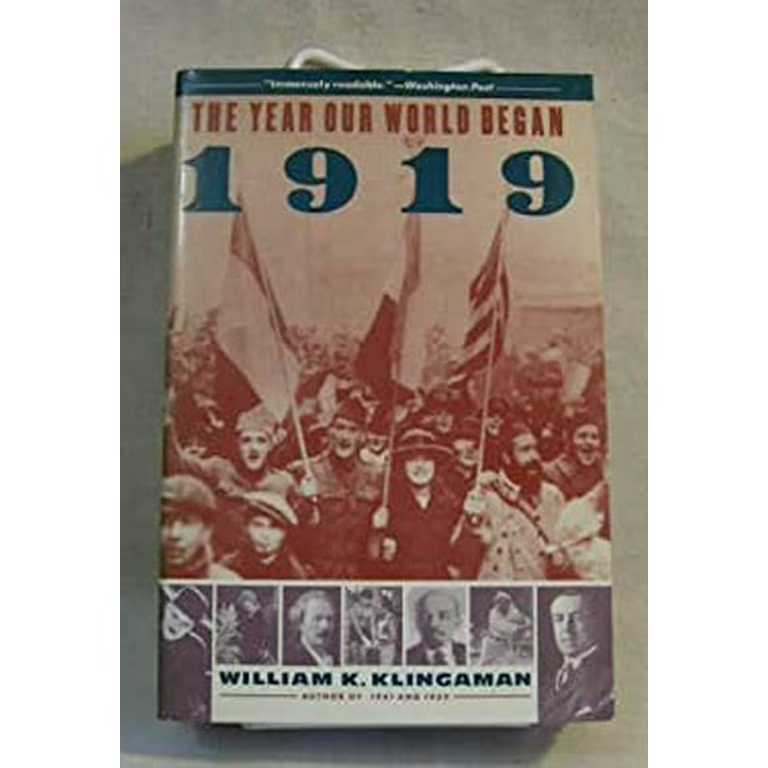
William K. Klingaman’s 1919: The Year Our World Began is one of those omnibus “histories of a single year,” a common form of pop history that often wearies the reader in its conflation of the momentous and trivial. Klingaman, fortunately, chooses a year that merits this approach: 1919, the year after the end of World War I which left the Old Order shattered, and a new one bloodily struggling to emerge. Klingaman’s book takes a strictly chronological approach, taking the reader through a detailed journey of the time that leaves scarcely a stone unturned. Klingaman is quite effective showing Germany’s brutal postwar era; racked by political turmoil after the collapse of the Hohenzollern monarchy, its people starving from the Allied blockade, with the country’s statesmen struggling to cobble together a workable state while under pressure from the Allies to accept the onerous terms of Versailles. More broadly, he explores the general wave of anarchy unleashed by war’s end: the new states in Eastern and Central Europe that immediately began squabbling over territory; abortive communist revolutions in Bavaria and Hungary; the Middle East, riven between the nationalism of various native peoples, the colonial ambitions of Britain and France and a renascent Turkey under Kemal Ataturk; India and Ireland, where longstanding colonial grievances erupted into mass protest and violence; and of course the Russian Revolution, which had long since descended into a bloody, multi-sided civil war, mass murder and widespread starvation. Klingaman expertly dovetails between these topics, while also exploring the Paris Peace Conference, Woodrow Wilson’s battling for the League of Nations while also repressing dissenters at home; sewn into the narrative are brief cultural asides on everything from the emerging postwar literature to the Black Sox scandal that provide color, rather than distracting from the broader narratives. Such a book is overwhelming, but never reduces its topic to a series of colorful anecdotes; Klingaman’s book, rather, is a highly readable, encyclopedic chronicle of a time when anything seemed possible, and just about everything did happen – except, of course, the creation of a stable peace.
7. A Nasty Little War: The Western Intervention into the Russian Civil War (Anna Reid, 2023)

Anna Reid’s A Nasty Little War revisits the doomed Allied intervention in the Russian Civil War, where various foreign powers (Britain, France, the US, Japan and many other states) ill-advisedly sent troops and political support to the White Armies resisting the Bolshevik takeover of Russia. Reid shows that the intervention was really a series of loosely-related military campaigns with a variety of contradictory goals; initially designed to secure military supplies from German troops overrunning Russia, British and American intervention then hoped to revitalize the Eastern Front to draw troops away from Germany’s onslaught in France. When World War I ended, the intervention’s goals became more nebulous, some wanting to bolster the anticommunist Whites while others (particularly Japan) harboring nakedly imperialist designs. There was little political will among the Western Allies for collective action; Reid shows Woodrow Wilson’s equivocations over the interventions, and how hawkish British statesmen like Winston Churchill had to overrule skeptical politicians and a war-weary public reluctant. With no direction or clear goals, Allied troops floundered in the frozen port of Arkangelsk, the South Russian oilfields and the vast expanses of Siberia, occasionally skirmishing with Bolsheviks, dying of disease and feuding with their Allies. Reid shows how the interventionists’ greatest “accomplishment” was giving free rein to White leaders (from the Siberian strongman Admiral Kolchak to the demented Cossack Semyenov and dashing Baron Wrangel of the Crimea) to indulge in their worst impulses, from graft to endless pogroms targeting Jews. The war, Reid convincingly argues, with a massive waste of men and resources, not only failing in its alleged goals but antagonizing the Soviet Union, sewing the seeds of distrust that led to a decades-long Cold War.
6. Trotsky: The Downfall of a Revolutionary (Bernard M. Patenaude, 2010)

Bertrand M. Patenaude’s Trotsky: Downfall of a Revolutionary (also published under the title Stalin’s Nemesis) absorbingly chronicles the final years of Leon Trotsky, the fallen Russian Revolutionary who spent his last decade as a “wandering exile” pursued across three continents by Joseph Stalin’s GRU agency. The book begins with Trotsky’s arrival in Mexico with his wife Natalya in 1937, where he’d been granted asylum by President Lazardo Cardenas in the face of international resistance. The Trotskys soon ensconced themselves in a small compound in Coyoacan, Mexico City, receiving a diverse collection of followers and admirers, from American intellectuals (notably educator John Dewey) and European socialist leaders to Mexican artists Diego Rivera and Frida Kahlo (with whom he had an affair). Even as Stalin’s show trials disposed of his remaining allies in the USSR (including one of his sons), Trotsky refused counsel from his prudent followers to lay low. Instead he published a steady stream of invective against the “degenerated worker’s state” his arch-rival had established, in speeches, books and political proclamations while attempting to convene a Fourth International to renew the Marxist revolution. Even after a Stalinist hit squad failed to kill Trotsky in May 1940, he responded by increasing his security detail and continuing to rage against his nemesis. Which continued for three more months, until Spanish Stalinist Ramon Mercader came calling with an article and an ax.
While Patenaude is hardly the first writer to cover Trotsky’s final years, his book is among the most engaging. He deftly weaves a portrait of Trotsky’s personal decline: still as charismatic and arrogant ever, he chafes at his virtual imprisonment, often snaps at his associates (from his long-suffering wife to his assistants, who are constantly chafing at his demands) and picks fights with his ostensible allies. He engages in behavior, from his affair with Kahlo (which entailed no small risk, considering Rivera’s violent temperament) to insulting political allies abroad, that seems as self-destructive as his constant poking of Stalin. Despite Stalin’s supposed “perversion” of the Revolution, his rigid adherence to dogma baffles and infuriates many of his followers, as when he defends the Soviet invasion of Finland as defense against capitalist encirclement. Patenaude also notes curious sidebars like Trotsky’s international followers commissioning a mock trial to clear him of Stalin’s charges, or his invitation by the Dies Committee to testify against Stalin (where Trotsky, to those red-baiters’ bafflement, planned to launch his call for the Fourth International). Even in exile, and even among his followers, Trotsky remained a combative and divisive figure; his status in power could drastically change, but his fundamental nature never yielded.
But Trotsky’s story, even for those unsympathetic towards his politics, can’t help evoking pathos: once one of the world’s most powerful figures, he’s reduced to a hunted man without a home, his family destroyed both by Stalin’s agents and circumstance, he and his wife unwelcome almost everywhere, left alone with his small collection of admirers, bodyguards and a collection of animals. Certainly he’s more sympathetic than the GRU agents who slowly draw the noose around him, from the Mexican muralist David Siqueiros (who led the team that machine gunned Trotsky’s compound in May 1940) to the fanatical Mercader, who survived a long jail term to become a decorated Soviet hero. His murder coincided with the Nazi occupation of France and American crackdowns on Trotskyist unions, which largely destroyed his organized following abroad, restricting Trotsky’s influence to ideologues and academics. In that sense Stalin succeeded, though he failed in that Trotsky’s image as the Compleat Revolutionary endures to this day, while few venerate his nemesis. After all, it’s easier to admire Trotsky’s Might-Have-Been than the sordid reality of Stalinism.
5. The Republic of Violence: The Tormented Rise of Abolition in Andrew Jackson’s America (J.D. Dickey, 2022)

J.D. Dickey’s The Republic of Violence chronicles the emergence of America’s abolitionist movement in the tumultuous 1830s, when Andrew Jackson was president and mob violence was a fact of American political life. Dickey shows that the abolitionist movement, though it had deep roots, was just emerging as a relatively mainstream group in conjunction with the rise of Jackson, a southern populist whose appeal to the populace mixed with a violent worldview that treated duels, riots and personal violence as a given. The book chronicles most of the familiar figures (David Ruggles, William Lloyd Garrison, Lewis and Arthur Tappan) and recounts acts of violence targeting abolitionists from Boston (where Garrison was nearly lynched by reactionaries) to New York (where both the Tappans and their Black friends and allies were subjected to repeated attacks) to Philadelphia (where Irish immigrants battled freed Black laborers), the Midwest and elsewhere. Dickey’s book covers the same ground as David Grimsted’s more scholarly American Mobbing, and draws similar conclusions: that violence became a method less of forcing social change than upholding norms, with its members targeting abolitionists, ethnic and religious minorities (particularly Catholic) and other outsiders; that abolitionists, African-Americans others who fought back were subjected to worse penalties than their attackers; and that politicians from Jackson on down, though they nominally denounced vigilantism, viewed the rule of law as entirely subject to their whims. Dickey adds a savage attack on the Colonization Society, which advocated resettling freed slaves to Africa; traditionally viewed as a “moderate” anti-slavery organization, Dickey emphasizes more recent historiography that they were themselves a colossally bigoted organization, that often organized the worst anti-abolitionist outrages themselves – thus, the “moderate” Colonizers were often more extreme than Calhoun-type slavery apologists. Grim reading, but well-done, and readers in 2024 need not be reminded of its applicability to the present; though readers can still take comfort in seeing how social reformers fought on in the teeth of such widespread resistance.
4. Vertigo: The Rise and Fall of Weimar Germany (Harald Jahner, 2024)

German journalist-historian Harald Jahner revisits the tumultuous days of the Weimar Republic in Vertigo (published in Germany two years ago, released in translation this year), a lively account that suggests without overstressing obvious connections to the modern day. Jahner’s book spends some time on the era’s political battles, but focuses largely on the cultural ferment and personal experiences of those who lived through it. From bloody street fights between left and right wing militias, to an unstable democracy and disastrous economic fallout, it’s all ably recounted here by Jahner, who feels that Weimar might have survived if not for the conservative and right wing factions (from the Freikorps extremists to the monarchist Paul von Hindenburg to, of course, the Nazis) who were constantly undermining it. Whether one finds this persuasive or not, Jahner’s book is certainly compelling in its account of the massive cultural shifts: changing ideas about gender and sexuality, the rise of politically charged art of all kinds, the liveliness of Berlin city life which, in turn, led to a massive backlash from conservative Germans who yearned from the stability of the Kaiser and the pastoral fantasies of the Heimat. Full review here.
3. Saying It Loud: 1966 – The Year Black Power Challenged the Civil Rights Movement (Mark Whitaker, 2023)

Mark Whitaker’s Saying It Loud offers a nuanced look at the radicalization of the Civil Rights Movement in 1966. Whitaker’s book starts by reviewing the state of the Movement at the time: having achieved epochal legislative victories with the Civil Rights and Voting Rights Acts, the movement’s leaders seemed to stagnate as Lyndon Johnson turned his attention elsewhere (not least Vietnam), race riots broke out in Northern cities and white backlash spread beyond the Deep South. Then the murder of SNCC organizer Sammy Younge during a voting registration drive in Mississippi drove the Movement in a newer, more militant direction. The main protagonists of Whitaker’s book are a mix of both well-known and more obscure movement leaders: Stokely Carmichael, organizing SNCC in Mississippi, through his charisma, drive and organizational skills; coining the phrase Black Power, he reenergized the movement with a new slogan and worldview that emphasized self-sufficiency over working with in the System. Also profiled are Julian Bond, who was being blocked from a seat in the Georgia State Legislature for speaking out against Vietnam; James Meredith, the hero of Ole Miss’s integration struggle whose one-man protest march in 1966 (and assassination attempt) provided a major catalyst for Carmichael’s militancy; Huey Newton and Bobby Seale, who advanced Malcolm X’s doctrine of self-defense by creating the Black Panthers; Ron Karenga, the radical Los Angeles organizer who preached racial separatism; and of course Martin Luther King, who struggles to keep the Movement together while confronting skepticism among young organizers, resistance from the Federal government and ugly backlash in Chicago and other Northern cities. Whitaker’s account is vivid and humanizing, articulating how Black Power seemed a logical response to the political state of 1966: after all, if working within the System only earns protesters a nightstick to the head. On the other hand, he doesn’t shy away from Black Power’s uglier moments, from the swaggering male chauvinism of Carmichael (“the position of women in the Movement is prone!”) and others to the personality feuds within the movement (exacerbated by the FBI and government intervention), the oft-murky ideological feuds (Marxism vs. Pan-Africanism vs. integration) and Bill Ware’s expulsion of white SNCC members, which Whitaker dramatizes in blow-by-blow detail. Ultimately, Whitaker concludes that Black Power played a major role in shaping self-esteem, identity and activism among African-Americans, a worthy achievement even if its political gains are harder to assess. A valuable addition to the literature on this heavily-covered, fraught and generally caricatured social movement.
2. Walking With the Wind: A Memoir of the Movement (John Lewis with Michael D’Orso, 1998)

A stellar counterpoint to the above work, John Lewis’s Walking With the Wind provides an engrossing look at the activist-congressman’s time with SNCC at the height of the Civil Rights Movement. Lewis discusses his life growing up poor in rural Alabama, his early attraction to speaking and the Civil Rights Movement, and his friendship and alliance with Martin Luther King. A key organizer of SNCC, Lewis was present at most of the era’s biggest events, from the March on Washington to the Selma marches and the Mississippi campaign which presages the Committee’s splintering, enduring beatings, imprisonment, death threats and constant ridicule – while also weathering infighting. Lewis’s book, with its lively conversational tone, is both bracing in its account of the Movement and also candid about its many inner conflicts; he notes that Southern members of the movement often clashed with Northern activists, many of whom viewed integration as a secondary goal to Black liberation. He’s equally forthright about his clashes with King over strategy (expressing his frustration at not being allowed to deliver a more militant speech at the March on Washington), his initially friendly rivalry with Julian Bond, his guarded respect for Malcolm X and his dislike of Stokely Carmichael, whom he views (harshly, but understandably from his perspective) as a self-aggrandizing wrecker. Lewis overcame to achieve major political victories, going on to become a long-serving champion of Civil Rights in Congress, and an icon to a later generation of leftists. Lewis also wrote a graphic novel account of his life (March), which is well-worth seeking out; he also inspired by a recent biography by historian David Greenberg. Yet this book might remain the best, most thorough account of his life, and one of the greatest volumes produced by or about the Civil Rights Movement.
1. Keeping the Faith: God, Democracy and the Trial That Riveted a Nation (Brenda Wineapple, 2024)

The Scopes Monkey Trial of 1925 surely has received ample coverage already, from books and memoirs to the famous play Inherit the Wind. With Keeping the Faith Brenda Wineapple, a brilliant cultural historian (The Impeachers, Ecstatic Nation, a stellar biography of Nathaniel Hawthorne), shows that there’s life yet in this old story, using it as a prism to view the tensions of early 20th Century America. The Scopes trial emerged in the post-WWI era, where America seemed to backslide into regressive politics and thought: the rise of evangelical religion and the Ku Klux Klan, the embrace of eugenics and race science, the passage of prohibition and flagrant corruption of the Harding-Coolidge administrations, led many intellectuals to despair that the country had abandoned reason altogether in favor of smug self-satisfaction. Thus when John Scopes agreed to become a “guinea pig” for an ACLU test case challenging Tennessee’s laws against teaching evolution, it was immediately seized by the press, public, politicians and intellectuals as representing. Wineapple expertly probes this background, showing that these strands of thought weren’t so distinct (it was for instance progressives who often embraced eugenics more readily than conservatives, who used this connection to discredit evolution) but that they all added up to a climate toxic for tolerance and thought. Wineapple dramatizes the trial, capturing the titanic personalities involved with shades of nuance lacking from other accounts: the swaggering progressive lawyer Clarence Darrow, viewed as a publicity hound seeking to rebuild his reputation after defending Leopold and Loeb; William Jennings Bryant, the evangelical tribune and three-time presidential candidate whose progressive anti-elitism easily translated into railing against intellectuals and scientists who thought they knew better than God. However innately dramatic the courtroom battles and flamboyant personalities, Wineapple shows that the Monkey Trial is a far more expansive story than two lawyers butting heads over a $100 fine. Perhaps the best account ever written of this oft-dramatized case, capturing the battles over science, religion, reason and politics that remain deeply embedded in America’s psyche.
Honorable mentions: The Boys on the Bus (Crouse); Judgment at Tokyo: World War II and the Making of Modern Asia (Bass); Kent State: An American Tragedy (VanDeMark); The Nemesis of Power: The German Army in Politics, 1918-1945 (Wheeler-Bennett); Passage Through Armageddon: The Russians in War and Revolution, 1914-1918 (Lincoln); Reds: The Tragedy of American Communism (Isserman); Takeover: Hitler’s Final Rise to Power (Ryback); When the News Broke: Chicago 1968 and the Polarizing of America (Hendershot).
What books (or documentaries/podcasts/etc.) did you especially enjoy this year?
You must be logged in to post a comment.