

Over the last few decades, comic book movies have reached heights of storytelling and spectacle that readers could never have DREAMED of. But for every triumphant high—The Dark Knight, The Avengers—there have always been a good number of stinkers… some bad enough to become punchlines or talking points, but most mediocre and ultimately forgotten…
Until they end up here.
The Discount Spinner Rack is where you’ll find the worst, the weirdest, and the most puzzling of comic book movie misfires. We’ll take a look at the things that actually work and the parts that absolutely don’t, and decide whether it’s worth your time and your dime. In the end, movies will be marked down on a scale from $1.00 (a surprise gem) to $0.05 (better used for kindling). This is the THIRTIETH SPIN of the Discount Spinner Rack, and to celebrate, we’re doing something a little different: we’re kicking off the BATMAN KNOCK-OFF PULP HERO TRILOGY, starting with the wonderfully oddball 1990 comic-strip adaptation, Dick Tracy!

In 1989, Tim Burton’s Batman changed the face of blockbuster cinema forever.
Studio executives were blindsided by the film’s runaway success. Most of them had passed on making Batman themselves in the early half of the decade1. And mainstream media outlets of the day still saw Batman as a kitschy relic of the ‘60s pop movement—what we might call a “dead meme” today. No one in the entertainment industry had even the slightest clue as to the character’s broad appeal… so when the film brought in over $400 million on a $48 million budget, they started fumbling over each other in a mad dash to figure out how to replicate it for themselves.
But this movie was NOT one of those fumblings. No, this one was something even stranger: a passion project, willed into being by Hollywood royalty after decades of false starts, that just happened to take shape at EXACTLY the right time (and in EXACTLY the right form) to cash in on the newly-shifted zeitgeist.
So let me ask you: what do you know about Dick Tracy?

Before Law & Order: SVU, before Dirty Harry, before Dragnet, there was Dick Tracy: the ur-example of copaganda. Created in 1931 by comic-strip writer/artist Chester Gould2, Dick Tracy was an American comic strip which followed a square-jawed plainclothes detective as he battled the forces of the criminal underworld in an unnamed major city that resembles Chicago. Tracy3 was loosely based on Eliot Ness, the U.S. federal prohibition agent who helped to take down Al Capone’s bootlegging empire by assembling a crew of officers known as the “Untouchables” to raid Capone’s businesses (they might have made a movie about it or something, I dunno); reflecting Ness’s reputation at the time, Tracy was depicted as an incorruptible man of the law, unmoved by bribery or threats, ready to answer the siren call of justice with a stiff right cross or a hot blast of lead. His initial adversary? “Big Boy” Caprice, a thinly-veiled Capone analogue, and one of the few recurring Tracy villains… because the bad guys in these strips had a tendency to die violent, gruesome deaths.

Though some criticized the strip as inappropriately violent, the lurid, pulpy crime stories were a huge hit with readers, and Dick Tracy soon became a household name.
Over the years, the strip began to amass a number of iconic elements. Dick Tracy was soon established to regularly wear a banana-yellow fedora and trench coat. In 1946, the strip introduced a two-way wrist radio—a distinctive and futuristic way for Tracy to get word of criminal activity, no matter where he was (quite the novelty in post-war, pre-cell phone America). And most pointedly, Tracy accumulated a vast and memorable rogues’ gallery of criminal arch-enemies, each with some strange defining grotesquerie to make ‘em stand out to the readers. Flattop Jones, the Brow, Pruneface, “Lips” Manliss, the Blank… Criminals in the world of Dick Tracy weren’t just bad or desperate people, they were literal monster men tearing a bloody swath through civilized society. Monsters waiting to be slain by a gallant dick in shining trench coat.
… WOW, that sounded way worse than I expected.

Tracy made plenty of leaps into other media in his first few decades… there were comic books (most of which were reprinted material from the newspaper strips), a radio show, a batch of movie serials, and even some legitimate feature film adaptations from RKO Radio Pictures4—the fourth of which, Dick Tracy Meets Gruesome, featured Boris Karloff himself as the titular terror menacing Tracy (Ralph Byrd). But the movies were all B pictures, and Tracy himself never transcended his role as a flat, colorful children’s adventure hero. He was a square-jawed cop who caught villainous crooks; that was enough.
Chester Gould stopped writing the strip in 1977, but it has continued publication all the way up the present day, under a string of writers and artists who’ve brought their own spins to the material (but most of whom have tried to stay faithful to the simple tone and appeal of the original strips). So considering the longevity and iconography of the property, it’s no shock that Hollywood would come calling soon about a grand-scale revival of the character on the big screen…
But what WAS a shock is how long it took ‘em to make it happen.

As it turns out, Dick Tracy languished in Development Hell for even LONGER than the single decade it took to get Batman made. Producers had been pitching a Dick Tracy movie as far back as the mid-1970s, with first United Artists, then Paramount Pictures and Universal Studios making deals to develop the film. Steven Spielberg was floated as an early candidate to direct by Paramount, but eventually John Landis (An American Werewolf in London, Trading Places) was selected for the director’s chair, with Clint Eastwood eyed for the title character (along with Harrison Ford, Tom Selleck, Richard Gere, and Mel Gibson—so basically every white, square-jawed leading man of the day). Before long, though, Landis would leave the project following the horrible accident that occurred on the set of Twilight Zone: The Movie in 1982; he was subsequently replaced by Walter Hill (48 Hours, The Warriors).
Now, Hill had a vision for the film as a gritty, violent period piece—and the studio seemed to be game for it, because pre-production advanced to the point that sets were being built. But unfortunately, Hill made a single, terrible mistake than ensured that his version of the film would never see the light of day:
He cast Warren Beatty as his leading man.

Beatty is a… complicated figure in Hollywood lore. One of the brash new talents to come out of the New Hollywood of the 1970s, Beatty’s a jack-of-all-trades who started out simply acting, but quickly moving on to writing, producing, and directing—often all on the same film. He’s been nominated for fourteen Academy Awards in various categories, but has only gotten the award once, for directing the 1981 film Reds (a famously tumultuous and expensive production that nevertheless earned major critical and financial success). Beatty was also a notorious womanizer who has allegedly slept with upwards of 13,000 women during his lifetime—and you might think that’s a totally pointless factoid to include, but somehow, it IS gonna be important later.
Anyway, point is, Beatty was an obsessive workaholic with an auteur mentality, who refused to compromise on his artistic vision… and HIS vision of the Dick Tracy movie was a colorful, stylized love letter to the simple comic strips of the ‘40s, which he’d grown up reading5. He and Walter Hill inevitably clashed on their competing visions for the film, and eventually BOTH men would exit the project—leaving it to stagnate at Universal, which tried unsuccessfully to develop the film into a lower-budget production. Eventually, time ran out and the movie rights reverted back to comic strip publisher Tribune Media Services…
… and then Warren Beatty swooped right in under the radar and optioned the rights HIMSELF for a cool $3 million.

Beatty took the project to Walt Disney Pictures (under their Touchstone Pictures label—which released more grown-up material than the Mouse House’s castle-branded imprint), and then he was off to the races! Studio head Jeffrey Katzenberger reportedly considered bringing in Martin friggin’ Scorsese to direct the film, but the idea was quickly nixed; after some back-and-forth, Beatty ultimately decided to direct the film himself, later explaining “it’s easier than going through what I’d have to go through to get somebody else to do it.”
Filming on Warren Beatty’s Dick Tracy began on February of 1989—four whole months before Burton’s Batman would premiere, so it’s unlikely that production designer Richard Sylbert (Chinatown, Who’s Afraid of Virginia Woolf?) was cribbing from the Dark Knight for the movie’s aesthetic direction. (It certainly had an effect on the film’s marketing, though—which used black, minimalist posters with cryptic taglines and no title or release date to heighten the film’s mystique.) When the movie was finally released the following June, it was a hit… but not nearly the Batman-scale hit that Disney’s execs had been counting on (grossing $162.7 million on a $46 million budget… but minus another HUNDRED million in marketing costs alone).

Plans to spin Dick Tracy into an Indiana Jones-type franchise were halted. The executive producers sued Beatty for unpaid profits. And in 2002, Tribune Media Services tried to reclaim the Dick Tracy movie rights from Disney (which had optioned them from Beatty), which led to a convoluted rights dispute being litigated in court and resulted in the production of…
(*sigh*)
… Look. I don’t want to have to get into the Dick Tracy Special for you. It was a thirty-minute television special produced by Beatty in 2008, specifically and explicitly so that Beatty could hold onto the rights to the character. And I REALLY don’t want to get into Dick Tracy Special: Tracy Zooms In, another 30 minute TV special shot in 2023 for the same damn reason. They are both exceptionally weird exercises in metatextual masturbation, and they’re both available on YouTube (HERE and HERE), so y’know what? Knock yourself out. And share your thoughts in the comments!

But what about the MOVIE, huh? What about the decades-in-the-making piece of auteur storytelling—the passion project from one of New Hollywood’s brightest stars? The one with an ABSURDLY stacked cast of A-listers and acting legends—like Al Pacino, Dustin Hoffman, William Forsythe, James Caan, Mandy Patinkin, and Dick Van Dyke, to name just a few? The one that Beatty actually convinced STEPHEN F%$#ING SONDHEIM6 to write a bunch of original songs for, many of which were performed by Madonna at the height of her superstardom? The one that nabbed seven Oscar nominations, and won for Best Original Song, Make-up, and Art Direction? WAS THAT ANY GOOD?

IN THIS ISSUE: A veritable feast for the eyes and ears… but it’s all empty calories and colorful candy shells.

Dick Tracy is a slavishly faithful recreation of the kind of uncomplicated storytelling you would get from a daily newspaper strip. We never get any kind of personal motivation for our title character aside from the fact that he’s, well, a cop—which is actually LESS motivation than the original comic strips gave him7. The main storyline is boilerplate cops-‘n-robbers stuff, with Big Boy (Pacino) making his move to control all the organized crime in the city because he is a CRIMINAL, and he likes to crime. And Dick Tracy is the only cop who can stop him, because he’s the only guy on the force with a strong jawline.
But the movie uses these well-worn clichés as a recognizable framework, so they can go absolutely apesh*t with visual stylism. To evoke the idea of a comic strip, the production design limited itself to only seven colors, and only one shade of each. The film uses matte paintings and model work to create a cartoonish recreation of an unspecified, Depression-era city. Characters dress in sharp, monochrome suits, and the gangsters are all made up in INCREDIBLY elaborate prosthetic make-ups to perfectly resemble the monstrous baddies from the funny pages.
Dick Tracy is basically a PG-13 Sin City—in Technicolor!

It’s kind of remarkable that this film went into production before Batman came out, because its approach to villains feels like they a studio executive saw the response to Jack Nicholson’s performance and said “we’ve gotta get a DOZEN Jokers for our movie!”
One would think every major character actor of ‘70s and ‘80s Hollywood got the call to get slathered in prosthetic make-up and dressed in garishly colorful suits. Paul Sorvino (Goodfellas) plays Lips Manliss, a guy with big lips; Chuck Hicks (an accomplished stuntman dating back to the ‘50s) plays the Brow, a guy with a big brow; William Forsythe (Raising Arizona) plays Flattop, a guy with a flat head—you seein’ a pattern here? Dustin Hoffman has a prominent role as Mumbles, a henchman who speaks in an unintelligible garble (with prosthetic smushed lips to give him a distinctive look), and James Caan even pops up as Spud Spaldoni, a crime boss who refuses to throw in with Big Boy and gets blown up (unfortunately, no, he does NOT look like a potato).

But the star of the show, the headliner, the ACTUAL Joker of this movie, is Al Pacino as Big Boy Caprice. Like Nicholson, Pacino uses Big Boy as a chance to bring out his id, to go hog wild with a big, brash performance that pushes all of his idiosyncrasies as an actor to burlesque extremes. Big Boy is an overgrown child, screaming and ranting and throwing temper tantrums, but he’s also constantly feigning wit and sophistication—making up quote after quote that he attributes to great men. Big Boy aspires to authoritativeness, but feels childishly entitled to it… which, yes, will sound VERY FAMILIAR to anyone who’s been paying attention to American politics for the last eight years8.
But here’s the thing about Al Pacino’s performance as Big Boy: I kind of hate it.

This may be the single most irritating, hammy villain performance I’ve ever seen. Pacino was already becoming a hollering parody of himself at this point; giving him license to act like a cartoon character on TOP of that was overkill. It’s 90% bellowing his lines. And somehow, Pacino netted an OSCAR NOMINATION for this role?!? I honestly think they only nominated him because they didn’t realize this was the exact kind of character he’d be playing for the rest of his friggin’ career.
Still, somehow Big Boy is the most fleshed-out villain in the entire movie… even if only aesthetically. See, most of the characters in this film are color-coded. Flattop always wears blue. Pruneface wears purple, obviously. Dick Tracy sticks to the banana-yellow9. But Big Boy is decked out in all SORTS of colors throughout the movie, and a lot of them have symbolic undercurrents. He starts out in a fairly neutral blue-green, which is his default… but as the movie goes on and his power and influence grows, we start seeing him in a purple shirt (purple symbolizing royalty) with green suspenders (symbolizing wealth). Near the end of the movie, when he has nothing left to lose and threatens to kill Tracy’s sweetheart, he’s wearing black (i.e. death, or possibly just slick fashion sense). But most interestingly, during his violent rise to power, Big Boy is the ONLY gangster in the movie to wear bright red—symbolizing violence and blood, but also symbolizing passion.
There are only two other characters in the movie who wear bright red… and they’re the people Dick Tracy cares about the most in the world.

Tess Trueheart (Glenne Headley, Dirty Rotten Scoundrels) is Dick Tracy’s long-suffering, ever-faithful girlfriend-slash-doormat, who wants nothing more than for Tracy to settle down to a nice, safe desk job and finally marry her. She’s obviously meant to be Tracy’s one true love (I mean, for God’s sake, it’s basically her NAME), but Tracy is skittish about commitment, and what it might mean for his crime-busting career… so a big chunk of this movie is about Tracy being tempted away from Tess by the ridiculously hyper-sexual femme fatale Breathless Mahoney (Madonna), a lounge singer under Big Boy’s thumb who’s witnessed all sorts of criminal behavior, but refuses to testify.
Probably the strangest thing about the film is the overblown sexuality of the Breathless Mahoney scenes. Over and over again, Breathless throws out some not-subtle-at-all innuendos to Dick, and Dick (ever the upstanding, honorable hero) doesn’t respond to them, at all, ever. But it gives the camera an opportunity to OGLE Breathless while she’s literally bending over to get Tracy’s attention—including the first scene, in which Madonna is wearing a nightie so sheer you can CLEARLY see her nipples through it. It’s a rather extraordinarily adult moment in a movie that is, otherwise, seemingly targeted at kids.

This subplot has been touted as the most personal part of the film for Beatty, what with him being a famously promiscuous himbo (see? I told you that was gonna be important!). There’s a bizarre tug-of-war between Tracy’s overwhelming but repressed desire for another woman (a red-lipped temptress who frequently dresses in black, suggesting danger and/or death) versus his half-hearted recognition that he should settle down with the dame he has real feelings for, even if the relationship isn’t exciting or fiery. Making things even more Freudian is the Madonna-whore dichotomy between the two women (no pun intended): Breathless is constantly dressing in sexy, revealing clothing and dropping HUGE double entendres on Tracy, whereas Tess is always bundled up in layers and played extremely chaste, more a motherly figure than a romantic one.
But ultimately, Tracy rejects the temptress to commit to a stable, monogamous relationship with Tess… and tellingly, only a couple of years after the release of this film, Beatty settled down with Annette Bening and got married. They’re still together today.

And as for that other character who dresses in red—the little kid? Well, that’s the character creatively named… the Kid!
Said Kid (Charlie Korsmo) is an orphan and street urchin who gets nicked by Tracy after swiping a guy’s watch. Initially a trash-talking hard case (“Go suck an egg!”), the Kid refuses to be brought to the orphanage, so Tracy reluctantly takes the boy under his wing—getting him cleaned up and well-fed, and before long the two start to form a bond. This is probably the strongest story thread in the film; their dynamic starts out mildly adversarial before developing into grudging respect, then admiration, then familial affection… which is more growth and change than ANY OTHER RELATIONSHIP in the film gets.
Also, the Kid is probably the closest thing to a proper kid sidekick that Hollywood has ever attempted in a movie, aside from maybe Short Round in Indiana Jones and the Temple of Doom.

The Kid ends up helping Tracy out of a life-and-death situation, and gets awarded a Junior Detective certificate for his troubles. He is, of course, elated… because in this world, cops are aspirational figures, and the Kid is here to give us someone through whose eyes we can LOOK UP to Dick Tracy.
Like the comic strips before it, this movie is pure, shameless copaganda. It presents policemen as unquestioned heroes and criminals as inhuman monsters. And in this context, Tracy isn’t just top cop—he’s a role model… nay, a superhero. He has specialized gadgets, like a wrist radio, and his own colorful costume. He solves problems with his fists and he has a dedicated rogues gallery. And this movie assumes that these superficial, comic-book-y elements are enough to distinguish Dick Tracy as a character worth watching, after decades—DECADES!!!—of cop media featuring far more complex and interesting leads.
It’s very, very wrong about that.

Dick Tracy sucks.
Part of that is the performance: Warren Beatty is terrible here. He spends half the movie trying (and failing) to convincingly play a tough-guy cop, and the other half gormlessly staring at his co-stars as they act AT him. He’s balsa wood with a gawping fish face. But a big part of why this performance falls so flat is that Dick Tracy himself is a nothing character.
All of his story conflicts are actually just the SAME black-and-white conflict, over and over—duty10 vs. selfishness. And when confronted with this choice, Tracy ALWAYS chooses duty. But there’s no DEPTH to this decision, because Tracy’s motivations are paper thin. He does his job because it’s his job. He sticks with Tess because she’s the “good” girl11. He does the “right thing” ONLY because it’s the right thing—because it’s what’s expected of him according to the rules of the society he lives within, rather than because he has any reason to CARE about doing the right thing.
And as a result, Tracy is a flatter and less dimensional character than basically any comic book superhero.
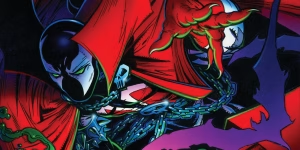
Superheroes always have a reason to do what they do. Spider-Man is driven by guilt. Batman is driven by anger. And even Superman, the big blue Boy Scout himself, is at least driven by compassion. He cares about people! He wants to help!
But there is nothing driving Dick Tracy. There’s no suggestion that he wants to protect people, or that he’s suffered at the hands of crime. There’s not even a hint that this is a power trip, or that he gets his kicks by leaping into danger. He is an empty shell, a cipher. He is defined exclusively by the parameters of the roles he assumes in society: cop, boyfriend, surrogate father. As such, he’s a full-throated endorsement of the status quo that created those particular roles, since he’s presented to us as an unequivocal hero.
Hell… he IS the status quo. He is the embodiment of cis-hetero, patriarchal, capitalist authority. He is The Man.
… Who the hell wants to root for THAT guy?!?

IS IT WORTH YOUR DIME?: I wish I could say “yes”. I WANT to say “yes”! But a movie can only get so far on aesthetics alone. The groundwork that all of these dynamic visuals are built on is flimsy at best, and for all of its plays at moralizing, its messaging isn’t nearly as wholesome as its retro trappings are trying to suggest. At its best, it’s an overproduced celluloid ego trip; at its worst, it’s regressive copaganda.

DISCOUNT PRICE: $0.25
FAVORITE BITS:
- The Blank: My favorite of the cavalcade of prosthetic-faced hobgoblins populating this world has to be the Blank—a mystery man in a black trench coat and hat, whose face is little more than a solid block of flesh (looking more than a little reminiscent of Steve Ditko’s later creation, the Question). But while the Blank IS actually a character from the comic strips (Frank Redrum, a murderer who blanked out his face with a piece of cheesecloth), in the movie this is actually just a disguise adopted by Breathless Mahoney in a brilliant ploy to bring down Big Boy and take over the city’s criminal operations herself. And she would have gotten away with it, too, if it hadn’t been for that meddling detective!

- Interviewing Mumbles: One of the funniest gags in the film is the fact that Dick Tracy only ever actively interrogates a single crook on camera: Mumbles, the incoherent, muttering lackey of Big Boy played by Dustin Hoffman. Early in the movie, Tracy hauls Mumbles in under the interrogation room lights while he’s still in his boxers, and Mumbles unleashes a torrent of indecipherable jabbering while, every few seconds, Tracy interjects with the same question: “where’s Lips Manless?” The cherry on top, though, is that the whole conversation is being transcribed by an exasperated stenographer… played by Kathy friggin’ Bates!
- Little Face, Little Face, Little Face: Holy God. Of all the bizarre visuals in this movie, the weirdest and most disconcerting have to be the close-ups of Little Face, the full-sized man with a tiny face. The effect is fairly transparent (it’s just a regular-sized man with an oversized prosthetic head and shoulders built around his face)… but that doesn’t make it any less jarring. You don’t see a lot of him—he’s only in about three shots—but he leaves an impression, especially because he pops up in the first five minutes!

- “Dick Tracy Jr.”: While Tracy’s in the slammer, framed for murdering the D.A. (in a subplot that only exists to pad the film’s runtime), the Kid comes to visit him and reveals that he’s finally taken a name for himself—handing him his Junior Detective certificate, now filled out with the name “Dick Tracy Jr.” In one of the best acting moments Beatty has in the entire film, we see him struggling to hold back tears as he smiles, telling the Kid that he’s okay with him taking on that name. It’s a simple and sweet interaction that actually made me FEEL something, after an hour and a half of cartoon cops-and-robbers nonsense.
- The Most Horrifying Mug in the Movie: So the most hideous, grizzled, monstrous puss in this whole friggin’ film doesn’t belong to Big Boy, or Pruneface, or any of the OTHER heinous gangster scumbags populating this world… it belongs to a single homeless man who’s never even given a name. When we first meet the Kid, we quickly learn that he’s swiping watches for some guy living in a shack off the train yards. We only see the guy’s face in two shots, but in his short screen time he batters the Kid and refuses to feed him, establishing him as the most detestable presence in the whole movie… which, given the propagandistic bent of the rest of the film, SEEMS to be painting the homeless as the worst, most base kinds of people in our society. It’s dehumanizing and gross.

NEXT ISSUE: Who knows what evil lurks in the hearts of men? The Shadow knows! Come back next time (it won’t be another year this time, I swear) for a look at the 1994 gritty supernatural noir featuring Alec Baldwin, Sir Ian McKellan, Tim Curry, and an absolutely HUMONGOUS prosthetic nose.
- Executive producer Michael Uslan had shopped the project around to all the major studios—and had been flatly rejected by ALL of them—before bringing it home to Warner Bros. ↩︎
- Originally under the title “Plainclothes Tracy”, which, uh… doesn’t quite have the same ring to it. ↩︎
- Whose first name actually IS “Dick”, but “dick” was also used as slang for a detective back in the day—so the title has a double-meaning. Technically it’s a triple-meaning, if you think cops are assholes. ↩︎
- The studio behind Citizen Kane and King Kong! ↩︎
- Beatty, in fact, credits the Dick Tracy strips for helping him to learn how to read in the first place—which may illuminate why this proved to be a passion project for him in the years to come… ↩︎
- One of the most accomplished and acclaimed musical theater composers of the 20th century, with some notable works of his being West Side Story, Sweeney Todd: The Demon Barber of Fleet Street, and Into the Woods! ↩︎
- He explicitly joins the force in his introductory story because Big Boy’s thugs murdered his girlfriend’s father… a motivation that rarely got touched on again after the strip took off. ↩︎
- I wrote this joke before Election Day. I guess we still have four more years of this bullsh*t to go… ↩︎
- … With a black-and-white suit underneath, symbolizing his faith in clear-cut moral right-and-wrong, and a red tie that symbolizes both humanity/passion and a capacity for bloody violence. ↩︎
- As dictated by the moral framework of the patriarchal authoritarian capitalist society he lives in… ↩︎
- And because the patriarchal heteronormative standards of society demand that he be in a stable, monogamous relationship with a girl, who can tie him down to domestic life and provide him emotional support… but only when he’s not on the job. ↩︎
You must be logged in to post a comment.