

In One Giant Leap, Katie charts the evolution of the platformer genre, one year at a time. This month: we cover the unexpected revival of the old-school platformer in a 4-part special, as Sonic Mania, Crash Bandicoot N. Sane Trilogy, Yooka-Laylee, and A Hat In Time each make their plays for the nostalgic Millennial.
I have talked before about the platformer genre experiencing a sharp decline in popularity during the 21st century, especially after the jump to HD in 2005-06. The genre was seen as too simple, too childish, not compatible with the Serious Adult Entertainment that video games were now all about. But the thing about children’s entertainment is, eventually those children grow up.1 And they have an appreciation for the art of their youth, and yearn for something new, but not too new to rekindle that flame. This phenomenon was a burgeoning trend on Kickstarter2 at the time for various games and genres. And for whatever reason, in 2017 it came for the humble platformer.
This year alone, there were four big-name3 platformers playing for this nostalgic audience, appealing to games from as early as 1991 and as late as 2002-ish. Some of them were official, some were not. And each one tells one part of the story of how a style now old enough to hold retro appeal was perceived in the ever-more-distant past.4 So I’m doing something a little foolhardy and looking at all four of them. Put your reading eyes on, it’s time to go on a journey.
Sonic Mania

Sonic, like rival Mario, is one of the only classic platformer series to have received frequent new installments since the genre’s heyday. But the two mascots are quite distinct in other ways. While Mario is a symbol of enduring quality, with instant masterpiece after instant masterpiece, Sonic’s record is spottier. Litigating exactly which Sonic games are responsible for this is an eternally cursed discourse; every Sonic game has supporters and detractors, even the ones you thought were unassailable classics, and especially even the ones you thought were universally derided. But a common position in this war is that Sonic lost its way when introduced to the third dimension.
Sonic Mania is a game for this camp. Fully 2D, with gorgeous pixel art graphics, and a chiptune-inspired new jack swing soundtrack. It feels like a Genesis game released circa 1996, a direct continuation of Sonics 1, CD, 2, 3, and & Knuckles. (To be clear, it absolutely would not have run on Genesis; this is a game interested in evoking a vibe, not restricting itself to the specs of 25 year old hardware) From the moment you hear the iconic “SEGA” chant on the opening screen you know what you’re here for.
And if that’s something you want, something you’ve perhaps wanted for the better part of 20 years, Sonic Mania delivers. A greatest-hits compilation of stages from the 5 classic games, plus remixes, plus new ones, all interwoven together. A true love-letter, one that drops a Dr. Robotnik’s Mean Bean Machine reference and knows the audience will be there for it, one that has Fang the Sniper5 in a cameo roll and expects the player to know who that is. There is no false advertising when it comes to Mania. If you love any of the 5 games it draws from, you will love it.
However.
Its inspiration is a hinderance as much as it helps. This is a game with a harsh lives system, where game over means restarting the entire zone from the beginning of Act 1 because that’s how it was in Sonic 3 & Knuckles. This is a game where bosses all take 8 hits to defeat, because that’s the series rule, even if for some more involved bosses (like the spider in Flying Battery Act 2) it simply drags things out. And it’s a game that preserves the series’ infamous squeeze death rules. Which, look. I get that it can be hard to make a universal rule that handles where to place the player when they get embedded in a moving wall. Death is a reasonable response. But Sonic games have always been far to aggressive with that trigger, and Mania preserves it in amber in the name of faithfulness. Like, look at this shit.
Did Tails get me? Tails, who the player can pass through? Or, look at this.
If you slow it way down, you can see Sonic’s bounding box just barely get caught between two moving squares as they shift position. In real time it’s indecipherable. And you mean to tell me you couldn’t have any other outcome? Your 2D fake physics system can’t handle keeping the player between the two boxes for a few frames without a failsafe death? You can’t even have a player hurtbox that’s smaller than Sonic’s sprite, so this kind of ticky-tack nonsense isn’t possible? I don’t believe that. This is a known mistake that did not need to be preserved to keep the feel of 2D classic Sonic. It’s here out of inertia, and the game suffers for it.
However.

This game was very well received, and I can’t really say the boosters are wrong. Sonic Mania delivers exactly what it sets out to. Fans of 2D Sonic have long since made their peace with its flaws. 2D Sonic has never been my cup of tea, despite almost being something I really enjoy. And that’s okay, things are allowed to not be for me. So let’s look at something that definitely is instead.
Crash Bandicoot N. Sane Trilogy
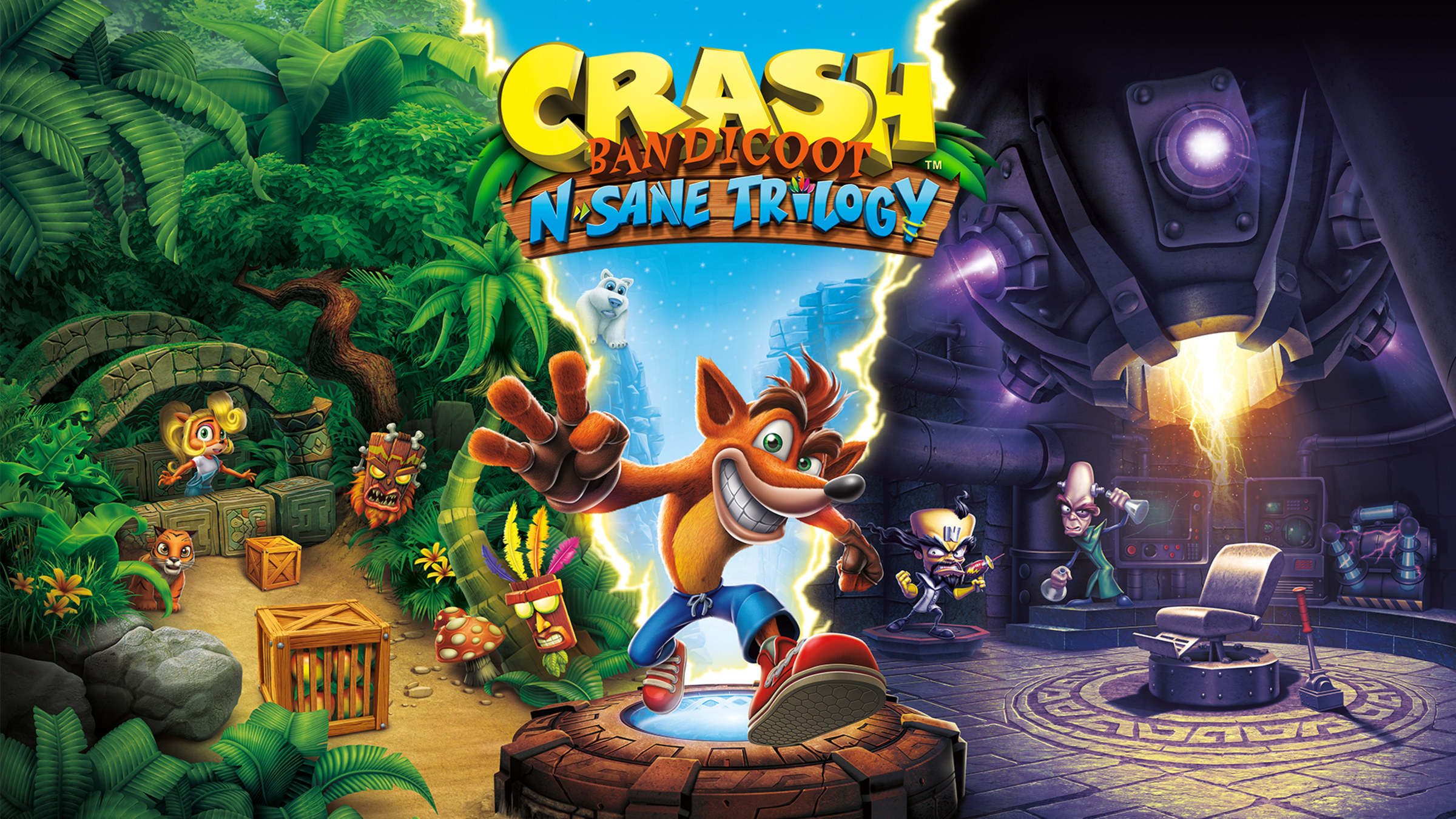
The original Crash Bandicoot trilogy, released between 1996 and 1998, are exactly my jam, 2 and Warped especially. These are games I played the hell out of as a kid, and still enjoy today. So when I saw Crash’s silhouette walk across the stage at E3 2016, I was hype. The games I loved, remastered with lush modern graphics? How could I say no?
Well, let’s dig into the first game of the trilogy. I never liked Crash Bandicoot as much as its two sequels. It’s a bit more stuck in the past, like a SNES game with polygons.6 Your opportunities to save are limited, and in order to collect a level’s gem you have to not only break every crate but also avoid dying, which is needlessly punishing and something the sequels dropped. One of the biggest opportunities a Crash remaster presented was the chance to sand down these rough edges for modern sensibilities.
And N. Sane Trilogy basically does. You autosave after every level, like any self-respecting modern game, and the deathless requirement for gems is dropped. Well, almost, anyway. Get through a level that offers a colored gem (needed to unlock secret passages in the game) and you might see this:

This choice is incomprehensible. Indefensible. Seemingly made without forethought. There is a similar, hypothetical choice you could defend, where the deathless requirement is preserved for all gems, and the game is presented warts-and-all. It would be less palatable to modern sensibilities, but there’s value in presenting the past honestly. It’s not the choice I would make, but it’s a choice I can respect. This, though. To smooth the game out for ~85%7 of its levels, only to bring back the Old Ways for the only gems that matter for anything beyond 100% completion…it’s like Tina Belcher hitting the only parked car in the lot. There are choices in game design that I don’t understand, or don’t agree with, but I can let go. I can’t with this. I’ve hated it ever since I first encountered it. It makes N. Sane 10 times more frustrating than it needs to be. If this choice was made on purpose8 I’m not sure I could respect the designer who made it.
And these sorts of thoughtless choices litter the trilogy if you know how to look for them. For instance, the player’s collision. In 3D games, collision detection is almost never 1-1 with an object’s mesh; to save processing, objects that collide are broken down into as few and as simple shapes as possible.

In N. Sane Trilogy, instead of checking collision against Crash’s9 exact character model, the game has a simple capsule shape. Very standard, a lot of platformers do this. Except, a lot of platformers today do this. Back on the PS1, you couldn’t afford something as luxurious as a capsule, what with all the tris that make up the ends. Most games back then used boxes, including the original Crash trilogy. Now, why does this matter? Let me share an example.
In this video, after I move Coco over the second bouncy crate I do not touch the d pad. She receives no additional input from me, and yet after a few bounces she slips off to her death. This is because her curved capsule catches the edge of the crate’s box, and every bounce pushes her slightly to the right. After a few bounces she’s been pushed too much and falls. This did not happen in the original games! A box mesh is pretty binary. You either overlap the object below enough to stand (or in this case bounce) off it, or you don’t. More modern games will have various methods to compensate for this drift, having the player enter a “ledge teeter” state, or grab the edge as they fall, or something. N. Sane doesn’t, because the originals didn’t. In the OG’s case they didn’t have it because they didn’t need it, but N. Sane gets caught in-between. By thoughtlessly doing things the way you’d do them in 2017 instead of 1996, the game made itself worse.
Hell, being thoughtlessly modern applies even to the game’s main selling point. The graphics of N. Sane are modern, with high poly models and fancy lighting and all sorts of stuff you couldn’t do on the first PlayStation. But there are some drawbacks to this. For instance, compare the following two images.


You can see the crystal in both of them. But on the left, the crystal really stands out. Everything has flat lighting, so the slight glow immediately draws the eye. On the right, the crystal blends in, the soft purple glow mixing with the slight glow off the light blue water and everything just gets lost in the mix. I straight-up missed this crystal my first time through, despite having played Crash 2 dozens of times. And beyond the practical considerations, is this softer style really Crash? The originals were angular because they had to be, yes, but that becomes an aesthetic! The higher poly renders for marketing were angular too. N. Sane makes things soft and rounded because That’s What Cartoons Are and it looks fine but it doesn’t look like the originals. It doesn’t match my memories, it certainly doesn’t match reality. It’s thoughtless. This whole game is thoughtless. And worse, its very existence destroys history. You can buy N. Sane Trilogy on all modern consoles, as well as Steam. This is unlikely to change any time soon. Meanwhile, the PS1 originals haven’t been ported to anything since the PS3, and this is also unlikely to change. If you want to play Crash, you either go out of your way to emulate the originals, or track them down secondhand, or else you play this haphazard imitation. N. Sane Trilogy is the worst kind of game, the one with a completed answer key that gets a B on the exam. In a vacuum, a B is fine. Given the context, getting a B means you are a special kind of worthless.

My opinion is atypical. Critics and players were generally fine with this game. It was mostly correct, and many of the ways it wasn’t resulted in the game becoming harder. This resulted in a “Crash Bandicoot is the Dark Souls of platformers” meme that probably killed “the Dark Souls of X” as a sincere way of denoting difficulty, but it’s accurate to the time. People shrugged, assumed the originals must have been harder than they remembered10 and moved on. The message is clear. Players are so hungry for old-school platformers that they will except quite a few compromises. With that in mind, let’s look at our next game.
Yooka-Laylee
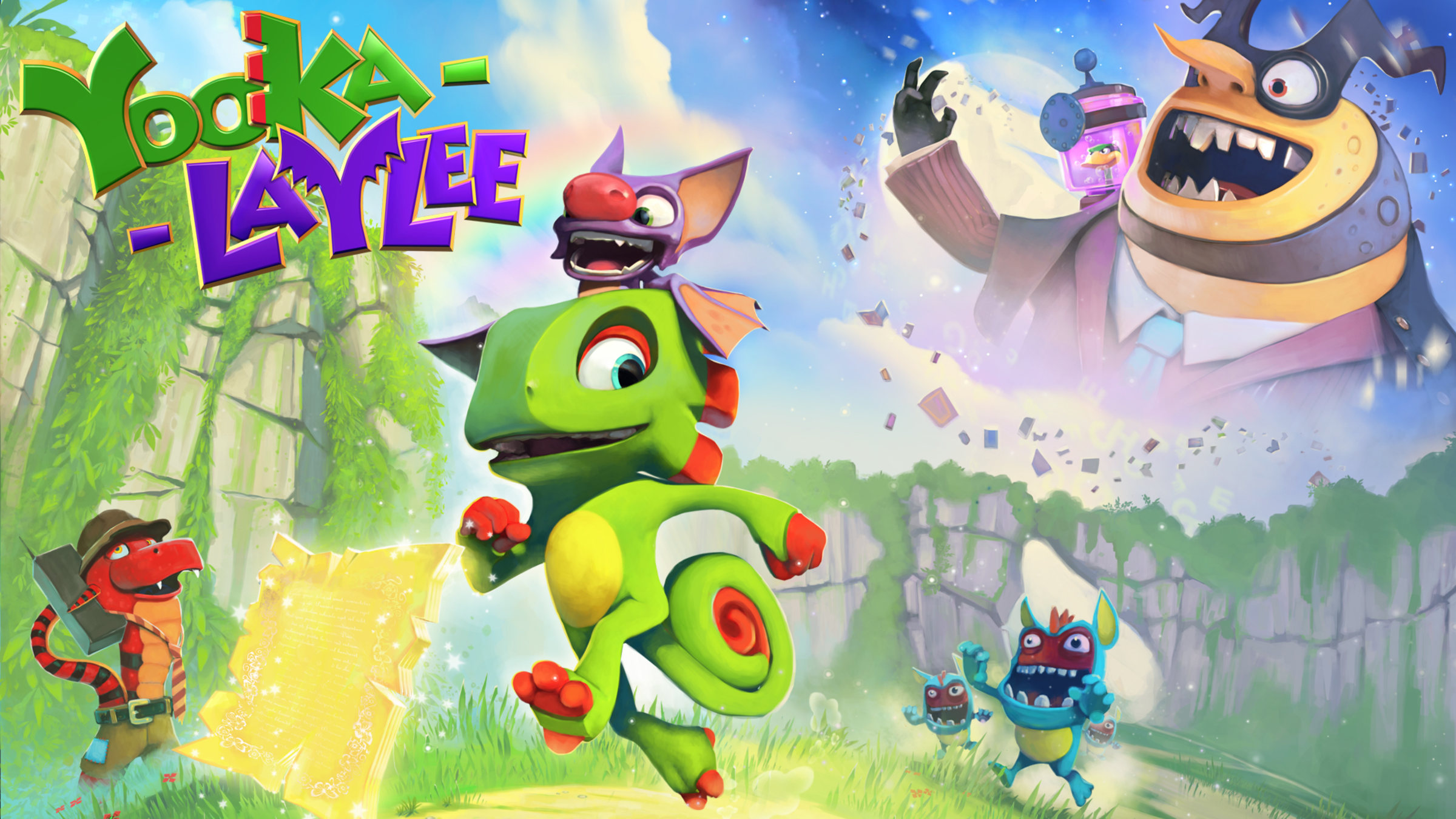
Yooka-Laylee is a Kickstarter game, featuring many developers who worked at Rare back in the late 90s. It’s a Banjo-Kazooie sequel in all but name, as Microsoft remained/remains content to sit on that IP and collect modest royalties on digital sales. Even more than N. Sane, I was hyped for this game. I even backed it! After all, Banjo-Kazooie is my favorite game of all time, and its own sequel leaves much to be desired. I needed more.
There’s a lot to love here. Yooka-Laylee intentionally throws back to an older philosophy, one that isn’t concerned with realism or in-universe justifications. There will be literal hoops to jump through, and you’ll like it. I have grow to despise “that’s too gamey” as criticism or feedback, and I can’t imagine that phrase was uttered once during YL’s development. This is a video-game-ass video game. You can feel the joy at being able to work like this again emanating from the game itself. The main bad guy is “Capital B”, a buzzword-spouting corporate exec type who the oldheads must have clashed against at Microsoft post-acquisition. It’s not exactly biting satire but it’s cathartic to anyone who’s ever worked in big-budget commercial art.11
This joyful retro attitude gets the game in trouble sometimes, though. Like many Kickstarter games Yooka-Laylee had stretch goals. Some of these goals promised specific gameplay features, things found in previous Rare platformers, such as a quiz show, transformations, mine cart segments, and local multiplayer minigames. Every element listed here is among the worst parts of the game. The mine cart, borrowed from the 2D12 Donkey Kong Country games, just doesn’t work in full 3D, twisting around in three dimensions. It’s impossible to judge jump distance, and the cannon that shoots “forward” relative to the cart’s current facing (rather than following the curve of the track) is basically useless. The quiz beat is repeated 3 times, and is bare-bones and prefunctory. The game board is a single line, nothing like the sprawling majesty of Banjo-Kazooie’s quiz. Plus, the joy in that quiz was how unexpected it was, that play doesn’t work again. The transformations and mini-games are more hit-or-miss. Like in Banjo-Tooie, they suffer mostly from being mandatory, meaning instead of including only the best ideas they were forced to come up with something for each level.
Which, let’s talk about those levels. Yooka-Laylee has 5 worlds, not including the hub. This is less than both BK (9) and BT (8). The worlds are much larger, and can be expanded once each as a way to try and squeeze extra juice out of them. But this size works against the game, especially since, like in Tooie, you need moves from late in the game to complete certain challenges in earlier worlds. The game encourages you to play a light tour on your first visit to a world, prioritizing enough quills to unlock all the new moves and just enough pagies to unlock the next level, and only once you have everything can you begin seriously completing each world. Since the worlds are so large, though, you wind up forgetting the lay of the land on those return visits. It’s just kind of a mess.
I see why the mess is there, however. There are only 5 worlds because it’s way harder to make an acceptable level at 2017 fidelity standards (even the fidelity standards of an indie cartoon game!) compared to 1998. 9 levels, each the size of a Banjo-Kazooie level but uniquely themed, would be significantly more work than 5 large levels. That’s just the reality of HD development. Yooka-Laylee tries to return to the past, but it’s not always as easy as it sounds.
Well, it could have been though. There’s no reason they had to make a game in HD, with modern fidelity standards. Maybe I’m talking crazy, but I think YL could have solved this problem by simply having retro graphics. Be like Sonic Mania but for the N64, big blocky low-poly models with low-resolution textures and pre-baked lighting. Use all the old tricks to make more with less, and suddenly your small team (but one larger than the original BK team!) can make a similarly scoped game. I’m not an expert on either art or production, so the specifics here may not be up to snuff, but the idea is sound. The biggest hurdle might just be if 2017 was really ready to embrace low-poly cool. I know in 2023 we have games like Lunistice and Pseudoregalia and Bloodborne PSX but back in the unenlightened times of 2017 I remember conventional wisdom being a lot more hostile to early 3D. “SNES looked amazing but PSX looked like butt” was just the prevailing attitude. And yet, if Playtonic had the courage I really think it would have taken Yooka-Laylee to the next level.
Still, overall I think Yooka-Laylee is successful at its aims. It promises a new Banjo-Kazooie, and it gives a game that feels like Banjo-Kazooie. There are flaws, sure, but mostly flaws we’ve seen in the source material. YL is, in my estimation, straight-up better than BT. All this points to another successful game, right?

Ouch. There’s two ways you can spin this. On the one hand, this is a game with 20-year-old ideas that doesn’t take them in new directions. Critics probably shouldn’t reward that! But, compared to Sonic Mania and especially the haphazard N. Sane Trilogy I have to at least suggest a more cynical take. Maybe, critics and players alike are happy to eat their slop, but only if a familiar face is feeding them. If a hypothetical Banjo-Threeie came out with Yooka‘s exact virtues and vices I’d bet quite a bit that it would score ~10 points higher purely on brand recognition. Whether critics were too harsh on Yooka-Laylee or would be too lenient on our hypothetical title is a matter of perspective.
Well, no matter. We need more from new faces? Let’s bring up our final title.
A Hat In Time

A Hat In Time is another Kickstarter game that promises a return to the golden era of collect-a-thons. But unlike Yooka it doesn’t feature a storied pedigree, and also unlike YL it doesn’t pull from any one predecessor. The closest analog is probably Super Mario 64/Super Mario Sunshine. The open-world 3D Mario had, at time of release13, lain dormant for 15 years. AHIT borrows the flow of these games; you have a few big levels, but you select an act ahead of time. This loads a unique instance of the level, and you get booted back out when you collect the Time Piece, this game’s star-equivalent. The game also borrows from Mario in terms of feel. You can double-jump, and also dive in the air, and also cancel an air dive with a jump (even if you’ve already previously doubled) and doing a full chain of jump+double+dash+cancel flows really well and feels like the sort of thing Mario would do, a series of individual moves that are a joy when used in conjunction.
But this game branches out. A Hat In Time has some light progression, as the objects you collect can be turned into new hats (which means new powers) or new badges, which give smaller benefits. It’s not an RPG by any means, but you’ll want different loadouts at different times, which gives a bit of depth to proceedings. The game is also very funny. There’s an inspired train murder mystery level that feels like something Psychonauts would have come up with.
If you love the 90s platformer, you’ll love A Hat In Time. But even if you didn’t, there’s more here than simple nostalgia plays. AHIT is maybe the ideal outcome from revivals. It’s undeniably part of the Old Ways. Mainstream games in 2017 weren’t doing this. But there’s also more here than just the stuff you recognize remixed ever-so-slightly so you can pretend it’s the first time again. There could be no better outcome of mining the late 90s than a game like this. So, naturally it must have been a runaway hit, right?

Well, that’s good. Not as good as that shitty Crash remake, though. Never mind, turns out slop is In this year. Back up the trough, boys!
Stray Observations:
- One thing I did like about N. Sane Trilogy was how it let you play as Coco in (nearly) every level. I naturally did so whenever possible, because goddamn did I live up to egg stereotypes at times.
- N. Sane is weirdly stingy with its animations. The original games have an animation in the jetpack levels of Crash freaking out at the blaring alarm before rushing to put on the jetpack gear. In the remake, you have a much more restrained confusion anim, and instead of actually putting on the gear there’s a metal privacy curtain that pops up and obscures everything. Like, come on guys. You can’t match 1997?
- Some other missing animations are interesting. Coco doesn’t have as many unique death animations as Crash, and at least some of them are pretty clearly because Certain Fans would be horny about them.14 On the one hand, Vicarious Visions is absolutely right that they’d be opening some doors better left closed. On the other, it kinda sucks to get less by playing Coco. I’m being penalized with a blander experience just because some dudes somewhere else can’t be normal. Don’t have a conclusive take here, just a thing I think about.
- Y’all I did not even get into everything wrong with N. Sane on a technical level. Each of the original 3 Crash games has different physics, because remaking everything from scratch was just how people did shit back in those days. But N. Sane tried to get away with the same physics for each game, and then had to change key numbers like max jump height after the fact to try and make things work. This results in things like Crash 1 having a faster fall acceleration than it’s supposed to, which sometimes makes things harder. No care. Complete rush job, how I despise it.
- Because I backed Yooka-Laylee, my (dead)name is in the credits. It is technically my first credit in a commercially released game. If I fuck around and accidentally become Known one day use that in trivia sometime.
- YL has a joke in its loading screen like “if this game was on cartridge it’d have loaded by now!” and like, I see what you’re going for but no. I’ve only ever played this game off of SSD (on PC and PS5), the problem is not raw read speed it’s how much is being read (plus optimization programmer shit, I’m a designer I don’t know things). Another argument for low-fi environments imo.
- Yooka-Laylee has a weird system where many moves drain a power meter, but almost none of the metered moves actually need to be restricted like this? Like, only a handful of late-game abilities need this, but they use it throughout the game I guess because that’s cleaner than springing a new mechanic on you late in the game. It’s rough. They should make a Twoka-Laylee and they should rethink this system in it.
- The PS4 port15 of A Hat In Time has weirdly sensitive triggers. I’d accidentally press them a lot. I feel like the console ports started on Switch, with digital triggers, and then was just never adjusted for consoles with analog triggers to add a minimum threshold? One of those small errors you kick yourself for missing if you’re the porting studio.
- Am I the only one who gets major UNDERTALE vibes from the Subcon Forest boss fight? A boss with metatextual awareness, who refuses to “turn blue” and thus become vulnerable? Hell, the fact that the specific color is blue? Even the music feels a bit like a Toby Fox composition.
- I promise this will be the only time I even acknowledge Metacritic. The reception of each of these titles is part of what makes the comparisons worthwhile, but “complaining about critics” is just such a hack mode, y’know?
Other 2017 platformers of note:
The game I would have chosen if I valued my time, 2017 also gave us Super Mario Odyssey. This was also a return to old platformer ideas, Mario’s first open 3D game since 2002. They learned a lot in those 15 years; Odyssey doesn’t boot you out of levels after each Moon, which is a massive one. The levels are larger, and denser, but not so large that you lose your way, even on return trips. Compared to some of the games on this list it feels a bit unfair; A Hat In Time managed a mere 40 Time Pieces, while Odyssey has 836(!) moons.16 Nintendo isn’t exactly AAA, but compared to everyone else making cartoony platformers they might as well be.
There was also a new 3D Sonic game, Sonic Forces. 3D Sonic had been doing an on-rails 2.5D thing since Unleashed, and had been largely succeeding since Colors. But with Forces the well ran dry. There’s just nothing to this game. It feels so hollow, and makes you question if you ever really enjoyed any of the previous boost-centric games. Which is a shame, because the tone of Forces is exactly My Trash. Fuck Mania, the heart of Sonic will always be some mysterious rodent with mystical powers saying “I was born in this pain, it only hurts if you let it.”
Also, you can create an original character, which is a neat and obvious feature given the immense popularity of Sonic fan characters over the years.
Next Time: Well, it was unavoidable. 2018 means Celeste, and Celeste means getting way personal about gender stuff. Also talking about a masocore masterpiece or something.
You must be logged in to post a comment.