
Welcome back to That’s Edutainment, which looks at educational video games of the past and considers whether they hold up today, focusing on their development and on the relationship between education and entertainment. Previous articles can be found here.
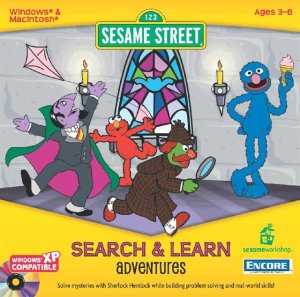
Today, we’re taking a trip to Sesame Street with 1996’s Sesame Street Search and Learn Adventures, a snapshot of not only edutainment in the mid-Nineties but a surprisingly experimental decade of the television show as well. Let’s begin!
Sesame Street premiered on the American television network PBS in 1969, and the first video game associated with the show was released just over a decade later in 1981. Titled Ernie’s Quiz, the game was developed by Children’s Television Workshop (CTW), the not-for-profit organization behind Sesame Street and associated properties. (As a historical note, Ernie’s Quiz came out four years before The Oregon Trail was widely released and became a watershed moment for the edutainment genre.)
Ernie’s Quiz focuses more on entertainment than education, and was released alongside two games unrelated to Sesame Street, the generally forgotten Instant Zoo and Spotlight. From that point onwards, the video game branch of CTW almost entirely dedicated itself to Sesame Street tie-in titles starring beloved characters from the show like Big Bird and Grover.
In 1995, CTW began releasing games such as Let’s Make a Word! and Get Set to Learn!, which depicted the larger world of Sesame Street in a video game format. These titles were often co-developed with Creative Wonders, a studio founded in 1994 as Electronic Arts (EA) Kids before teaming up with the American Broadcasting Company television network in December of 1994 and renaming itself Creative Wonders. The studio’s new name and logo debuted at E3; Creative Wonders’ president Greg Bestick told one publication that the new name “reflects the engaging experiences found in [each of] our products–experiences that excite the emotions, stimulate learning, and provide entertaining, yet valuable lessons.”


Creative Wonders rose to prominence as the developer of licensed games for such franchises as Sesame Street, Madeleine and Schoolhouse Rock!, as well as educational reference titles that also served as tie-ins for ABC productions. Bestick told Billboard magazine in 1995, “Our publishing strategy is to use branded content of the highest quality, to make full use of all the programming groups at ABC, to build lines of products so that you can create some critical mass at retail, and [to do] some cross-collaborative marketing.” Because the companies involved were directly involved in these titles’ creation, the games had a fairly high production value, and featured voice talent from the original properties. This was also the case with Search and Learn Adventures, first released in 1996.
One might expect that Search and Learn Adventures would star some of Sesame Street’s biggest personalities, like Grover or Big Bird. Instead, it’s focused on two relatively lesser-known characters: enthusiastic sleuth Sherlock Hemlock and his trusty canine companion, Watson.


Sherlock Hemlock made his first appearance on the show in the Season 2 premiere in 1970, and began to appear more often starting with Season 20 in 1989, especially in the show’s Mysterious Theater segments. It seems that Search and Learn was either designed around Sherlock and Watson from the start, or someone on the development team just really liked the characters; nods like this to Sesame Street lore give Search and Learn much of its charm. That charm is evident from the game’s opening moments onwards, as Search and Learn’s three difficulty levels are represented by quintessential red telephone booths.
Sherlock and Watson arrive on Sesame Street following a catastrophe: famously inept magician The Amazing Mumford has made all of the items gathered for a beach picnic disappear. The items are now scattered throughout Sesame Street, and it’s up to Sherlock and Watson to explore each location, solve puzzles, and find the missing items.


The structure of Search and Learn owes a lot to the point-and-click adventure gameplay popularized by studios like Humongous Entertainment in the 1990s – there is a sort of inventory, and Humongous’s signature interactive ‘clickpoints’ are here as well. (This wasn’t the only point-and-click adventure game Creative Wonders made; a more traditional-style adventure game, Madeline European Adventures, was also released in 1996.) I was unable to find any information about the game’s development, but it’s easy to imagine someone at Creative Wonders or CTW looking at, say, Freddi Fish and the Case of the Missing Kelp Seeds and saying, “I want a game like that.” Search and Learn is somewhat linear in structure but remains able to surprise; for example, there’s a secret passage in the Count’s castle seemingly designed to reward inquisitive players.
Despite its cheerful atmosphere, Search and Learn was released in the middle of one of Sesame Street’s most experimental – and most turbulent – eras. Some of the show’s more notable behind-the-scenes figures passed away in the late 1980s and early 1990s, among them series creator Jim Henson, “Bein’ Green” songwriter Joe Raposo, “Rubber Duckie” writer Jeff Moss, CTW founder and executive producer David Connell, and openly gay puppeteer Richard Hunt.
In 1993, a brand-new set, ‘Around the Corner’, was unveiled during the show’s twenty-fifth season. The creation of Around the Corner was driven largely by financial concerns, as the show struggled to compete with the wildly popular Barney & Friends, which had debuted on PBS in 1992. As a result, Around the Corner featured an expanded cast of both human and Muppet characters, including Zoe, one of the first female Muppets on the show. The new set also boasted new locales, such as the store Finders Keepers and the Furry Arms Hotel, many of which are prominently featured in Search and Learn.

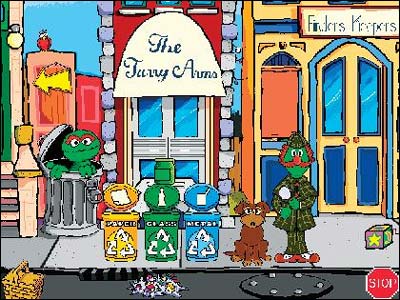
However, the existence of Around the Corner was short-lived; the set was gone by the end of the show’s twenty-ninth season in 1998, and only a few aspects of this era, such as Zoe, remained. As Sesame Street puppeteer Martin P. Johnson later noted, “It was a great cast and the plot lines were hilarious, but research discovered that kids couldn’t keep track of all these people and puppets, making the shows visually exciting and entertaining for adults, but confusing for kids.” Additionally, research showed that the show’s established, ‘magazine-based’ format no longer reflected children’s television viewing habits in the late 1990s. (Much of this is detailed in Michael Davis’ 2008 nonfiction book Street Gang: The Complete History of Sesame Street, which later inspired a 2021 documentary.)
CTW responded by introducing a new, narrative-based segment called Elmo’s World at the end of each episode, starring the iconic red Muppet of the same name. Elmo had been introduced as a character in 1985 and was already popular by the end of the 1990s – the brawl-inducing Tickle Me Elmo toy debuted in 1996 – which reportedly led to the creation of Elmo’s World. (I’m certain that if Search and Learn had been released at any point after 1996, it would have starred Elmo instead.) Thanks to Elmo’s World, Sesame Street shifted to a new, narrative-based format, and entered the twenty-first century with a brand-new and highly successful creative approach.
Given the rapid changes in the show’s history surrounding the creation and release of Search and Learn, the game could easily come across as little more than a curio. Indeed, by the time Search and Learn was re-released in 1998, young players unfamiliar with the Around the Corner era of Sesame Street might view environments like the Furry Arms as locations created specifically for the game.
Like Around the Corner, Creative Wonders all but vanished by the end of the 1990s. In October 1997, the New York Times announced that the studio would be acquired by The Learning Company, which was similarly absorbing other competitors in the edutainment market, including Carmen Sandiego developer Broderbund. By 1999, Creative Wonders was reportedly entirely folded into The Learning Company. Many of the studio’s games, including Search and Learn, would be re-released in later years by whoever had the rights to them at the time – including Mattel, during its disastrous and short-lived acquisition of The Learning Company in the early 2000s.
Creative Wonders was one of the shortest-lived studios during edutainment’s heyday in the mid-Nineties, lasting only four or five years, but accomplished something notable, or at least remarkable, during that time. While the studio was created to develop tie-in educational software for television networks and other companies, Creative Wonders managed to imbue those products with care, thoughtfulness, and humour one might not expect from such titles.
Tie-in games tend to have a mixed reputation, and rightly so in some cases; for every genuinely inspired title like Spongebob Squarepants: Battle for Bikini Bottom or Neopets: The Darkest Faerie, there are many held in lesser regard. Search and Learn’s grounding in classic adventure game structures, and its endearing homages to Sesame Street’s past, have ensured it remains notable, decades after its release.
Next time: We begin our second annual Summer of Carmen Sandiego miniseries with 2004’s action-adventure-stealth platformer Carmen Sandiego and The Secret of the Stolen Drums. See you then!