

July 4 is the birthday of Mary Edmonia Lewis (1844-1907), the first Black American professional sculptor and the first artist of African-American and Native-American heritage to enjoy international fame and critical recognition. Lewis was a younger contemporary of Harriet Hosmer, the first female American professional sculptor. Like Hosmer, she worked in the Neoclassical idiom while also depicting subjects that related to her own background, interests, and political philosophy. In Lewis’ case, this included the abolition of slavery, Native-American themes, and, later on, biblical figures.
Although the details of her early life are murky, the picture that emerges from an examination of various accounts indicates that Lewis, originally called by her Ojibwe name, Wildfire, was born free, either in Greenbush, New York or in Ohio, in 1844. Her mother was Catherine Lewis, an Ojibwe and African-American artisan, and her father was a free Afro-Haitian gentleman’s servant, some identifying him as the writer Robert Benjamin Lewis (a notion that is not universally accepted). Lewis’ parents both died by the time she was nine years old, so she and her older half-brother, Sunshine, later known as Samuel, were adopted by two of Lewis’ maternal aunts and raised with their tribe near Niagara Falls.

In 1852, Lewis’ brother ventured west to San Francisco, where he became a successful prospector during the California Gold Rush. Lewis remained in the east and was mentored by prominent abolitionists while she pursued her education, which her brother funded. She attended Central New York College, McGrawville and Oberlin Academy Preparatory School in Ohio before changing her name to Mary Edmonia in 1859 and enrolling at Oberlin College, one of the first American universities to admit women and people of color into an integrated, coeducational environment.
Despite the ostensibly liberal atmosphere at Oberlin and despite the support she received from Rev. John Keep, a trustee of the university, Lewis was subjected to racism and violence. She was falsely accused of poisoning her roommates, was severely beaten by vigilantes, and, at a later date, was accused of stealing art supplies. Though acquitted of all charges, Lewis was expelled from Oberlin in 1863, just one semester short of her graduation.
The following year, Lewis, bearing a letter of introduction from Rev. Keep, moved to Boston and began studying with Edward Augustus Brackett, a popular sculptor whose clientele included the poet Henry Wadsworth Longfellow. Lewis’ early work was well received. However, she soon had a falling out with Brackett (for reasons that are lost to history), and it became clear to her that she needed to leave the United States in order to have a career in art, so she moved to Rome in 1865.
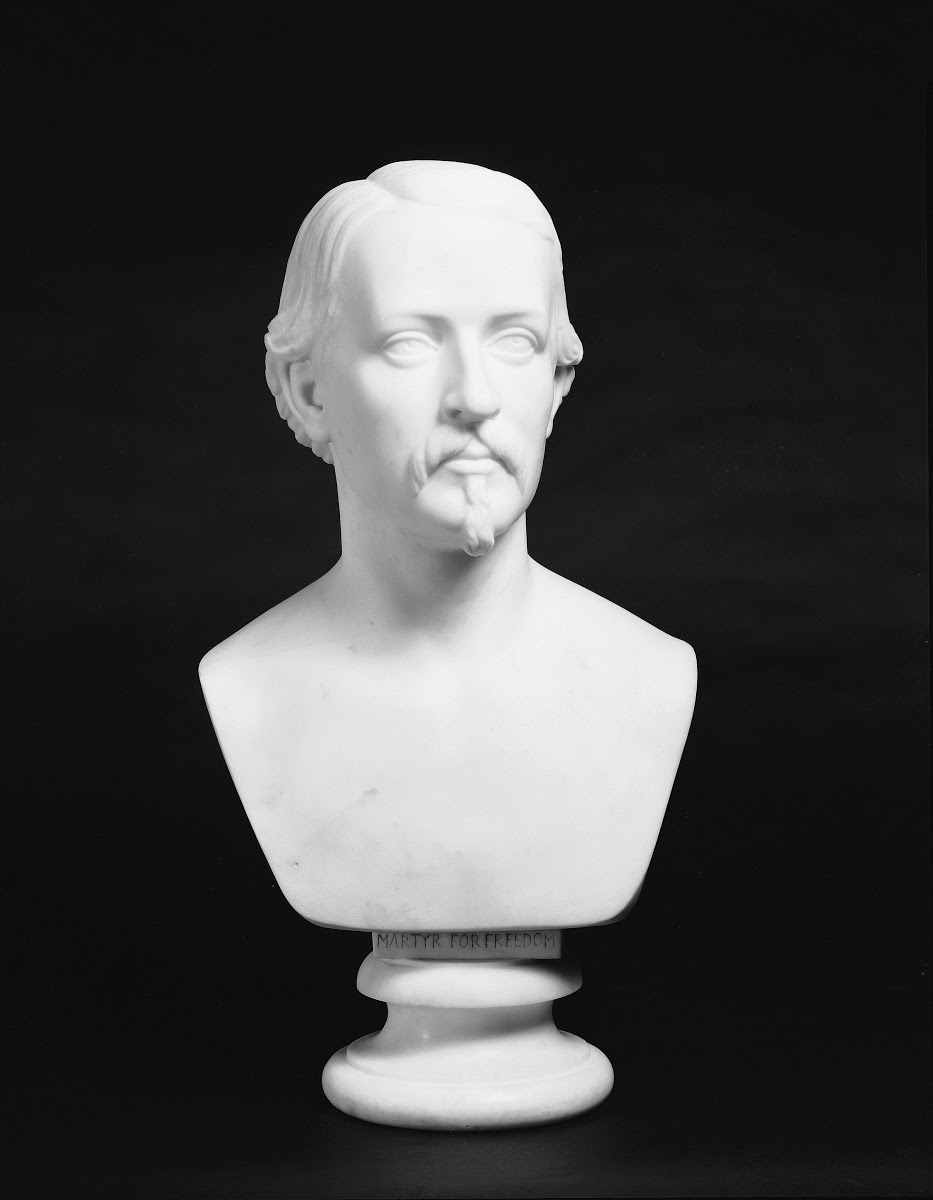
Looking back on her decision in later years, Lewis said: “I was practically driven to Rome in order to obtain the opportunities for art culture, and to find a social atmosphere where I was not constantly reminded of my color. The land of liberty had not room for a colored sculptor.”
In Rome, Lewis flourished personally and professionally. She learned Italian, converted to Catholicism, joined a community of expatriate, female Neoclassical sculptors (including Hosmer), and perfected her craft, sculpting in her favorite medium, Italian white marble. Lewis worked alone on her statues, whereas it was common in Roman studios for an artist to create a model and then have other sculptors help realize the full sized, final version. She was strongly motivated by the desire to foil any possible racist assumptions that she couldn’t do her own work.

As her critical acclaim increased, Lewis’ work sold for substantial amounts of money; a 1873 article in the New Orleans Picayune reported her acquisition of two $50,000 commissions, astronomical sums in the 19th century. She also utilized the bold strategy of sometimes sending unsolicited sculptures to her clients in Boston with the request that they raise money for the works and their shipping costs…which they did.
Though she continued to live in Rome, Lewis often went back to the United States to exhibit and sell her work. She traveled across the country in the 1870s and was one of the first sculptors to exhibit in California. Lewis reached the pinnacle of her career in 1876, when she was invited to display her most famous work, Death of Cleopatra, at the Philadelphia Centennial Exposition.

The statue created a sensation, because it deeply unsettled contemporary viewers; it struck them as a darker, more serious-minded approach to the subject than they were used to seeing. Though Cleopatra’s suicide was frequently portrayed in the art of the period, Lewis’ depiction of the Egyptian queen’s dishevelment, her head having rolled to one side at the moment of death, was considered shocking. Its gravity stood in sharp contrast to the softer, more romanticized, and more overtly sexualized representations of Cleopatra’s death by other, mostly male, artists. Death of Cleopatra garnered Lewis high praise for her artistic skill and was followed closely by a 1877 commission from Ulysses S. Grant for a portrait bust.
Just a few years later, Lewis disappeared from the world’s stage, and we know very little about her last decades. The most salient fact of her later life was the decline of her career in the 1880s, when Neoclassical art fell out of fashion and the center of the art world shifted to Paris. Beyond this, research focusing on census data, legal documents, and burial records has only recently provided a small corpus of facts with very little connective tissue. To wit, at some point during or after the 1880s, Lewis moved from Rome to London; she is not known to have married or had children; and she died of kidney disease at Hammersmith Infirmary on September 17, 1907 at age 63. In accordance with her religious beliefs, she was interred in St. Mary’s Roman Catholic Cemetery in Hammersmith.

Over the years, Lewis’ grave, marked only by an uninscribed marble slab, had fallen into disrepair, and its association with Lewis had faded from memory. However, following its recent confirmation as her burial site, it was restored with money raised in a 2017 GoFundMe campaign by Bobbie Reno, the town historian of East Greenbush, New York. The original slab was conserved, and an additional gravestone with Lewis’ name was commissioned.
Edmonia Lewis should be remembered not only for her body of work, but also for her indomitable spirit and her drive to cultivate an enormously successful career during a time when the art world was deeply hostile to women artists and virtually inaccessible to Black people, especially in America, where slavery had only been abolished in 1865. Lewis spoke candidly about her determination in the face of numerous obstacles when she said:
“Sometimes the times were dark and the outlook was lonesome, but where there is a will, there is a way. I pitched in and dug at my work until now I am where I am. It was hard work though, but with color and sex against me, I have achieved success.”