
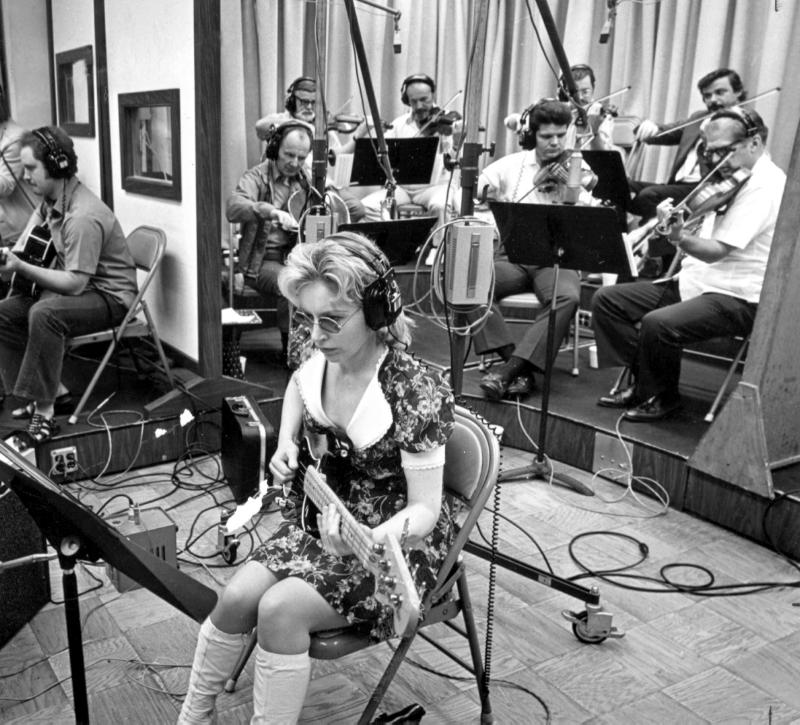
Carol Kaye is a guitar and electric bass player whom you’ve undoubtedly heard, even if you’ve never heard of her. Born in Washington State in 1935, her family moved to Los Angeles in 1942. Both of her parents were professional musicians, but it was something of a spontaneous decision when her mother bought her a guitar at age 13. Within just a few years, she was playing bebop gigs at clubs all across L.A., and toured the US with the Henry Busse Orchestra.
In 1957, she was playing just such a gig when a record producer approached her and invited her to play the recording session for “Summertime” sung by Sam Cooke. That one session paid more money than several weeks’ worth of club dates, so she made it known that she was interested in doing more. She played acoustic rhythm guitar on “La Bamba” with Ritchie Valens, and that session brought her to the attention of Phil Spector, who began hiring her regularly.
She was on a session in 1963 when the bass player failed to show, although a rented instrument and amp were already there. Kaye was asked to fill in on bass, and immediately she discovered that she preferred playing bass over six-string guitar. With her jazz background, she was able to improvise and compose her own bass lines, an ability which producers appreciated, and she quickly became the first-call bassist in the L.A. studio scene just as pop music was exploding.
Record labels in the mid-’60s faced a dilemma: groups like the Beach Boys were so popular, it didn’t make sense to take them off tour for any length of time. But then how were they to record new songs? The answer: session musicians. A record producer would bring in a group of session musicians and the bare bones of an idea for a new song. Together, they would create an arrangement and lay down a backing track. Then the actual members of the band would lay down the vocals at a later date, and learn “their” instrumental parts sometime after that. The session musicians accomplished more in three hours than what most bands of the ear could have done over several weeks. Carol Kaye can be heard on thousands of such records.

Plenty are familiar, others are not, such as this 1969 release by Mel Tormé. Notice how effortlessly cool Kaye sounds on her bass line, while Tormé is desperately trying to stay relevant (himself a product of the Swing Era, he’d once called rock ‘n’ roll “three-chord manure.)
By 1970, album-oriented rock was becoming more popular and more bands were insisting on playing their instruments themselves on their own records, and Kaye herself had gotten burned out from doing multiple sessions at different studios every day. But she was seamlessly able to transition to doing recording sessions for film scores and TV themes, including for The Streets of San Francisco, Across 110th Street, Mission: Impossible, and Bullitt. This led to working frequently with Quincy Jones, who was being hired to compose many TV themes and film scores in this era, and recycled much of that material for use on his own albums:
Carol Kaye just celebrated her 91st birthday on March 24.
You must be logged in to post a comment.