
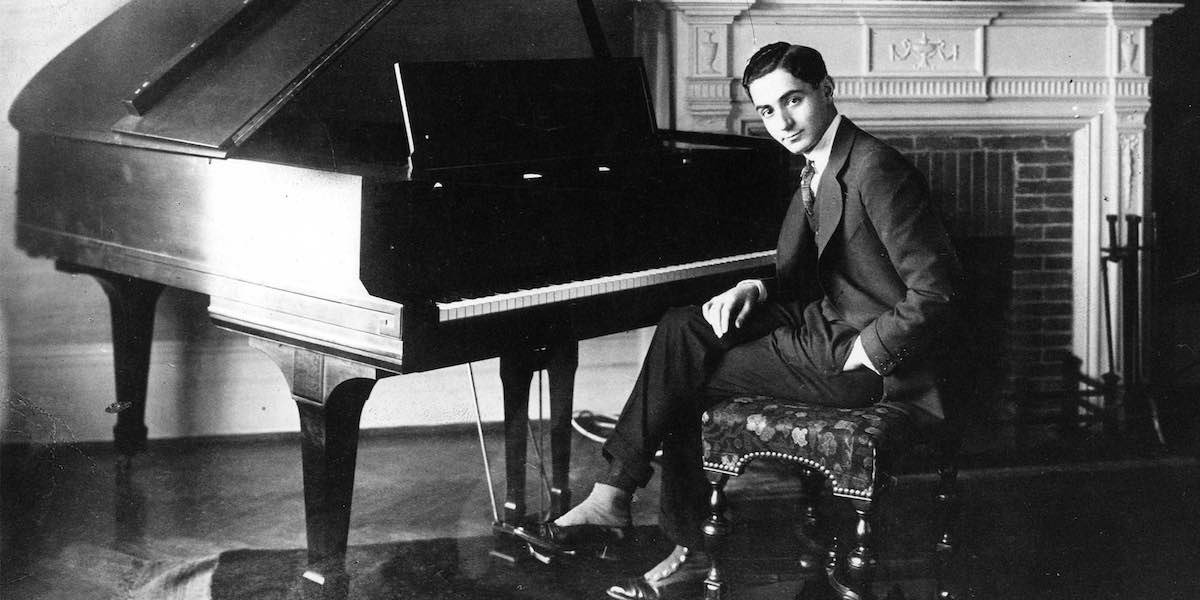
The songwriter Irving Berlin was born Israel Isidore Beilin in Tyumen, Siberia, Imperial Russia, in 1888. His father was a cantor originally from a village in what is now Belarus; the move to Siberia was presumably because there was a synagogue and Jewish community there willing and able to pay for his services.
The family – Irving, his parents, and his seven siblings – left Russia in September, 1893. They took a boat from Antwerp and arrived at Ellis Island on Sept. 14. Later in life, Berlin told his biographer that he retained no memories from his early childhood in Russia, save one: spending the night lying on a blanket at the side of the road, watching his family’s house burn to the ground.
The family settled in New York City. Berlin’s father died in 1901, which forced young Irving to leave school and begin working full-time. But the only work he could find was as a paperboy, although he quickly learned that customers would toss him a few extra pennies if he sang the songs he heard coming out of saloons. By 1906, he found a job as a singing waiter at the Pelham cafe in Chinatown. He became a hit with customers by singing parodies of popular songs, changing the lyrics to make them “blue.”
After hours, he taught himself to play the piano – although only in the key of F-sharp, achieved by almost exclusively using the black keys on the keyboard. (Later in life, he had to have a custom piano made which could transpose to other keys while he continued to play in F-sharp.) He then composed an original song – “Marie from Sunny Italy” – and sold it to a publisher for a royalty of 33 cents. He was off and running.
Irving Berlin wrote so many songs – and so many of them became hit songs – that even just listing the hits would take up too much space. But considering the time of year, it’s inevitable that I would focus on his most famous Christmas song, “White Christmas.” It was written for the 1942 film Holiday Inn. Released as a single sung by Bing Crosby and Martha Mears, it sat at No. 1 on the pop charts for 10 weeks, and sold 50 million copies. Naturally, the song got recorded by numerous other artists, and many of those records became hits, such as for The Ravens, whose swinging version reached No. 9 on the R&B charts in 1949:
Irving Berlin never received any formal musical training. In fact, his friends and fellow composers such as George M. Cohan and Victor Herbert advised him that since he was such a natural talent, learning music theory would likely only cramp his style. Most of his most famous songs were written before he ever learned to read or write music notation. He learned other people’s song by ear (just as when he was a paperboy) and right through to the end of his career, he composed his songs entirely by ear and had an assistant transcribe them so that they could be sent off to the publisher. He died in his sleep in 1989 at the age of 101.