
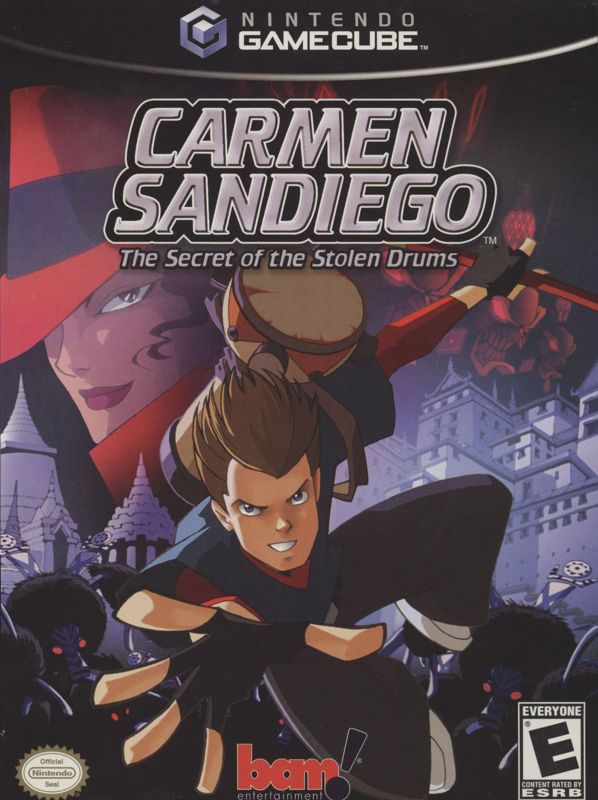
Welcome back to That’s Edutainment, which looks at educational video games of the past and considers whether they hold up today, focusing on their development and on the relationship between education and entertainment. Previous articles can be found here.
Today, we’re looking at the 2004 title Carmen Sandiego: The Secret of the Stolen Drums, the long-running series’ first (and perhaps misguided) attempt at joining the modern console era. The header image is from MobyGames; all other images are credited throughout. Let’s begin!
The Carmen Sandiego series is one of edutainment’s most established and beloved franchises, but it’s also a deeply weird one. Since the first game in the series was released in 1985, titles have occupied a wide variety of genres, from arcade-inspired globe-trotting to point-and-click adventures.
As such, an action-adventure-stealth-platformer like Secret of the Stolen Drums might not be as much of a stylistic departure as one might assume – and while Stolen Drums turned out to be more of an evolutionary dead-end for the franchise and edutainment as a whole, it also suggested new directions for educational gaming in the modern console era.
Stolen Drums emerged as a collaboration between Riverdeep, the educational software publisher that had acquired the Carmen Sandiego franchise in the early 2000s, and California-based publisher BAM! Entertainment. Founded in 1999, BAM had become known for a variety of licensed tie-in games, mostly for Cartoon Network properties such as The PowerPuff Girls and Dexter’s Laboratory. The partnership seemed promising at first; a Riverdeep executive declared the below in a 2002 press release:
We are excited to team up with BAM! to bring Carmen Sandiego to the video gaming world … Her mysterious and clever nature has intrigued kids for many years. She’s not an evil villain, but she is certainly a prankster, and a character we feel will transfer very well to gaming platforms.
BAM’s president stated in the same press release, “Carmen Sandiego is a well-established brand, standing the test of time and various line extensions beyond her PC roots … it is the perfect property to bring to gaming consoles and a new generation of players.”
The game itself was developed by Artificial Mind & Movement, a studio founded in 1992 and based in Canada. I was unable to find specific information about how or why Artificial Mind & Movement was chosen to develop Stolen Drums, but the studio’s output could have played a role. By 2002, the developer already had a diverse portfolio of tie-in titles, adapting everything from the Jim Carrey Grinch movie to the animated film Ice Age, for a variety of consoles and platforms.
While Stolen Drums boasts Carmen’s name in the title, the game itself has remarkably little to do with the globe-trotting thief. In Stolen Drums, a jewel containing all of the world’s knowledge has been hidden in a temple in the African jungle. The map to the temple was written on the skins of eight drums subsequently hidden around the world. The player controls the blandly-named rookie ACME agent Cole Gannon, who tasks himself with tracking down both Carmen and the drums, visiting everywhere from New York and New Zealand to Paris and Peru.
Unlike previous entries in the series, Stolen Drums doesn’t particularly focus on the search for Carmen. Instead, most of the gameplay is spent dealing with two types of antagonists: Carmen’s army of robots and a variety of elemental spirits awoken by the gem. Carmen’s robots are disarmed using Cole’s weapon of choice — a staff — and yield passwords that unlock progress-impeding gates in each level. Elemental spirits are more traditional video game enemies, and dispatched through direct combat.

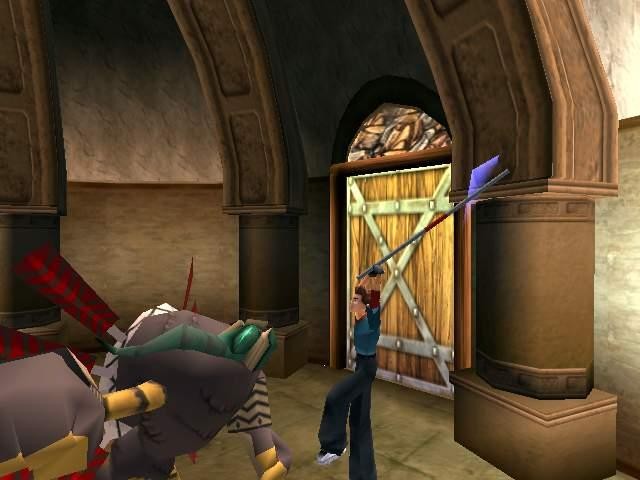
The game’s combination of action and stealth was a key part of its development. In an interview with Game Chronicles, a BAM producer noted that “[w]e wanted to get as much action and combat in [Stolen Drums] as possible, while still maintaining the integrity of the [Carmen Sandiego] brand. We decided that we could have combat as long as the main character didn’t hurt anyone.”
The educational aspects of Stolen Drums take a backseat to its more action-based elements. Information about each locale is presented through narration by Jules Argent and Shadow Hawkins, the protagonists of Treasures of Knowledge, the previous game in the franchise. Stolen Drums ends not with an exciting chase to catch Carmen, or the use of knowledge acquired throughout Cole’s adventures, but with a boss battle against a giant lava monster. It’s a strange way to reintroduce an education-themed franchise to a new generation, and difficult to imagine where the series would have gone from here.
Stolen Drums was released for Playstation 2, GameCube, and XBox in the PAL region in March of 2004, and in North America later the same year. The game received poor-to-middling reviews upon release; GameSpot gave the title a score of 4.7 and advised, “Don’t go into The Secret of the Stolen Drums thinking you’re going to get an educational game or an enjoyable platformer, as you’ll find neither here.” IGN was slightly more complimentary, giving the game a score of 5.6 and praising its graphics and sound, while observing that “derivative platforming has taken the place of sleuthing and fact finding.”


The game might have been an outlier for the Carmen Sandiego series, but it does exist in conversation with other titles developed and released around the same time. The gameplay of Stolen Drums feels indebted at least in part to Sly Cooper and the Thievius Raccoonius, which was released in 2002 to commercial and critical success. Like Stolen Drums, Thievius Raccoonius emphasizes stealth over direct combat and features a staff-wielding protagonist.
One could also draw similarities between Stolen Drums and the 2003 title Tomb Raider: The Angel of Darkness, which also sought to reinvent an iconic Nineties franchise, featured stealth-oriented gameplay, and introduced an underwhelming male co-protagonist. Angel of Darkness was commercially successful but derided by critics and longtime fans, negatively impacting the overall reputation of the Tomb Raider brand. (Angel of Darkness gained a following in subsequent years as an ambitious, if flawed, cult classic, and was remastered alongside other Tomb Raider titles in 2025.)
I was unable to find sales figures for Stolen Drums, but one could conclude from the lack of readily-available information that the game wasn’t particularly successful. As far as critical re-evaluations go, Stolen Drums appears to lack the status of either a beloved favourite or a cult classic, and hasn’t been the subject of many retrospectives or video essays. Even the speedrunning community, which has helped bring underrated early-to-mid-Aughts titles like Angel of Darkness and 2005’s Neopets: The Darkest Faerie back into the cultural consciousness, has largely ignored the game. It’s rather disheartening that a game like Stolen Drums, which seems to had a fair amount of expectations placed upon its success, failed to rejuvenate an aging franchise and usher in a new era.
The aftermath of Stolen Drums saw varied outcomes for the parties involved in its development, mirroring the game’s own mixed reception. BAM had been faced with potentially having its stock delisted from NASDAQ in February of 2004, and published its last title in February of 2005; by June of 2006, the publisher was reported as having declared bankruptcy. Artificial Mind & Movement continued releasing both licensed and original titles, changed its name to Behaviour Interactive in 2010, and is perhaps now best known for the survival horror title Dead by Daylight.
As for Riverdeep, seven years went by before the company released another title in the Carmen Sandiego franchise. (The brand didn’t go entirely dormant – a title from an unrelated French studio and publisher was released for PC and Nintendo DS in 2009.) Riverdeep’s next Carmen game, Adventures in Math, an episodic title released for the Wii in 2011 and 2012, focused on point-and-click-style gameplay and puzzle solving, and was more closely aligned with the franchise’s earliest titles.
While Stolen Drums’ attempt at melding action and education was a non-starter for the Carmen Sandiego series, it arguably anticipated subsequent original titles from other developers and publishers in the console era. Games such as 2005’s Shadow of Rome and 2007’s Assassin’s Creed similarly combined stealth and action to various extents, and were often based on or inspired by historical events.
In the end, Stolen Drums was more of a stylistic diversion for the Carmen Sandiego series than a clear direction forward, and unsuccessfully attempted to bring Carmen into the sixth generation of console gaming. Perhaps one day we’ll get a console title that properly showcases the franchise’s blend of entertainment and education. Overall, Stolen Drums seems likely to remain a curio of Aughts-era console gaming, and a peculiar offshoot of a long-running series.
Next time: We continue our Carmen Sandiego retrospective with a look at 2009’s Mais où se Cache Carmen Sandiego? Mystère au Bout du Monde, otherwise known as New Carmen Adventure, released for PC and Nintendo DS. See you then!