
Futurama – being a show that’s been cancelled, then revived, then cancelled, then revived, then cancelled, then revived yet again – has an interesting relationship with its own mortality.
Ever since that first cancellation by the Fox network, Futurama has never taken its future as assured. Each season, they make sure to close with an episode that, if the cancellation axe falls, will serve as a fitting series finale, ending the show with a sense of closure.
Now, on its own, that’s not such an odd thing. Buffy the Vampire Slayer famously constructed each of its season finales to also work as a potential season finale, since for most of the show’s run they never knew if they’d be renewed for another season till after the current season was written. However, Buffy was a show that embraced serialized storytelling and evolving characters. For them, a series finale was an episode that resolved the major storylines, saw the main villain defeated, and brought the characters to an emotionally satisfying point in their journeys – and if the show got renewed past that point, then they’d create new villains to battle in the coming season, and send the characters down new journeys, picking up from where the series season finale left them.
But Futurama ain’t that sort of TV show. It is a staunchly episodic, status quo driven series – across more than 150 episodes, only a handful of events have had any lasting effect on the characters or their lives. While Futurama likes the idea of ending with the characters in a different place from where they started, it doesn’t want to have to deal with those changes if that ending ends up not being the end.
They tried doing the epic, nothing-will-ever-be-the-same sort of finale once, with Into the Wild Green Yonder. Being rescued from cancellation for a series of direct-to-video movies was such an improbable bit of good fortune, no one was seriously betting on it happening a second time. So they went all out in the final act, having Fry & Leela finally get together, the Planet Express crew declared fugitives, and them all setting off through a wormhole for new adventures in an unknown part of the universe …
… then they got revived by Comedy Central, and backtracked on all that quick as they could. The wormhole just dumped them back on Earth, the criminal charges were promptly dismissed, and while Fry & Leela didn’t quite go back to square one, it took most of the Comedy Central run for the show to actually commit to them as a couple, rather than only remembering their relationship when it was convenient to the story (much like how they only occasionally remember that Nibbler can talk).
Futurama learned from that mistake (well, they see it as a mistake) – it still constructs its finales to provide the illusion of change and closure, but in a way that won’t actually change anything if the show continues on. The tone will suddenly get wistful, major upheavals will occur in the characters’ lives, and those upheavals will (for once) be treated semi-seriously. Then they close with an exploration of what the characters’ futures will be like now that their lives have changed … but through Futurama‘s timey-wimey sci-fi shenanigans, they assure us that future won’t actually happen to the characters we know.
“Overclockwise” has Bender prognosticate what the future holds, but since we don’t get the specifics of the prediction (just Fry & Leela’s reactions) they’re not committed to any future events. “Meanwhile” has Fry and Leela live a long, full life together, but then reset time when they start the world moving again. “All the Way Down” has our characters receiving a moment of joy and celebration that will be time dilated to last for centuries – but its versions of the characters one rung down the simulation ladder, so the main version of the cast keeps going on as always.
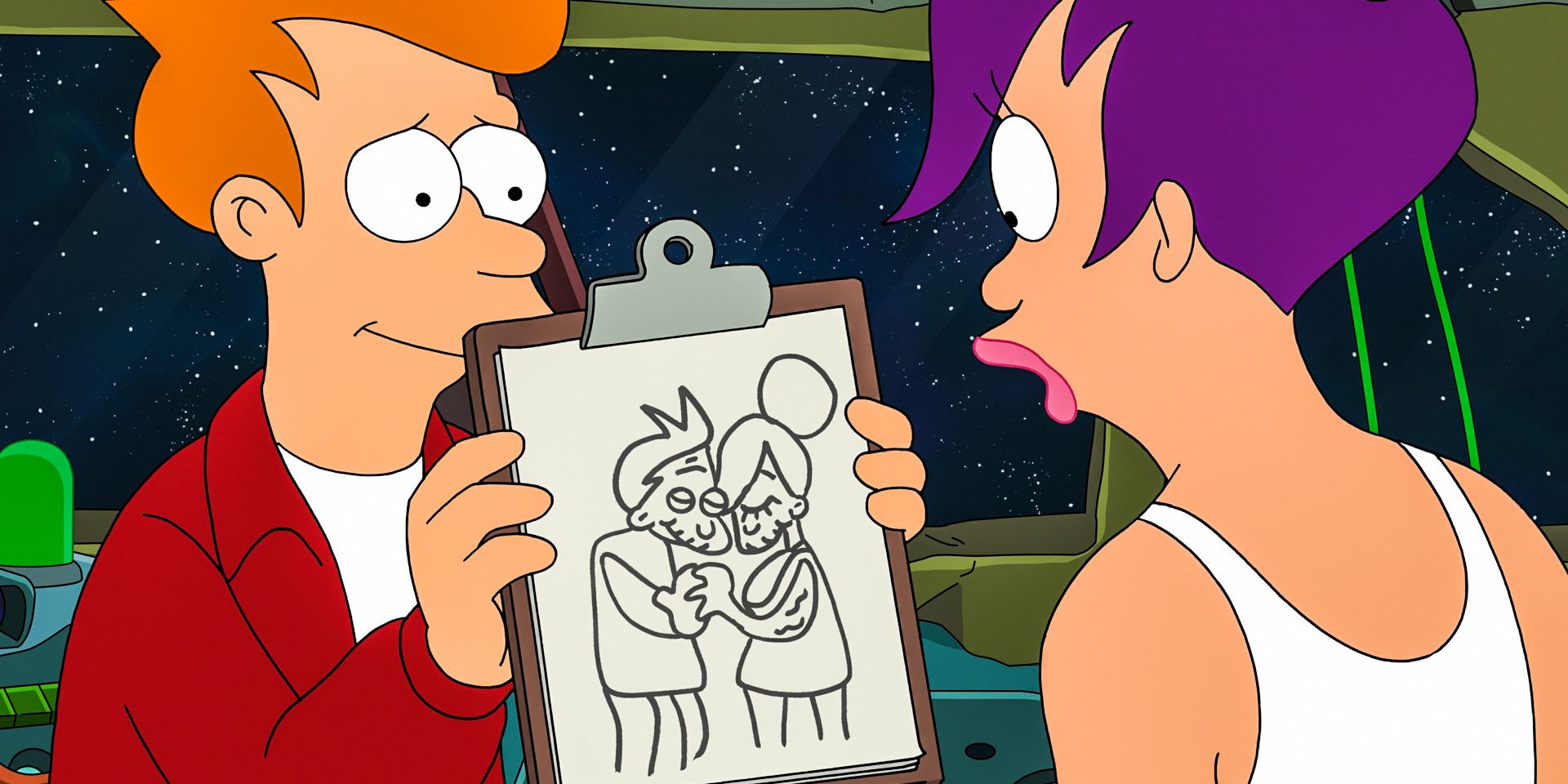
And now we have “Otherwise”, where we get the old Planet Express ship being destroyed, Fry remembering the events of “Meanwhile”, Fry & Leela getting married (again), and our main crew dying in a blaze of glory … but it’s all an alternate timeline, so none of that’s going to affect the show going forward.
And the show is going to keep going forward. Before this episode came out, Hulu had already announced that Futurama was renewed for two more seasons. And watching this ep knowing it’s definitely not going to be the series finale, makes it feel rather odd.
It’s not just that I know all these major changes aren’t going to stick. Even on the level of tone and story structure, “Otherwise” is built like a series finale. When the Planet Express ship is replaced, or Fry starts remembering alternate timelines, those events don’t cause a rapid fire series of wacky plot turns like they would in a normal Futurama episode. Instead, the episode sets these things up and mostly just sort of lingers on them, the story becoming wistful as it contemplates what they mean.
If this really were the last episode ever, that’d make perfect sense – it’d be our big goodbye to the series, so slowing down to reflect on everything would be a proper note to go out on. But since this ain’t the last episode, the turn to the melancholic feels distractingly out of place.
Nevertheless, despite that odd vibe, and despite doing the everything’s-changing-but-also-everything’s-staying-the-same twist yet again, I quite enjoyed “Otherwise”. It’s not going to best “Meanwhile” or “The Devil’s Hands Are Idle Playthings” in the series fauxnale rankings, but it still does its job well. That the emotional arc is based on calling back to a previous fauxnale makes it feel more impactful, and even though I called the ep “melancholic”, it’s still often laugh-out-loud hilarious (anything involving the Planet Express can opener, who’s apparently always been the most respected member of the crew, is absolutely aces).
This isn’t the end of Futurama, but it is the last we’ll see of it for the next year, so I’m glad they were able to go out on a bit of a high note, even if they stick a little close to the Futurama template for series finales.