
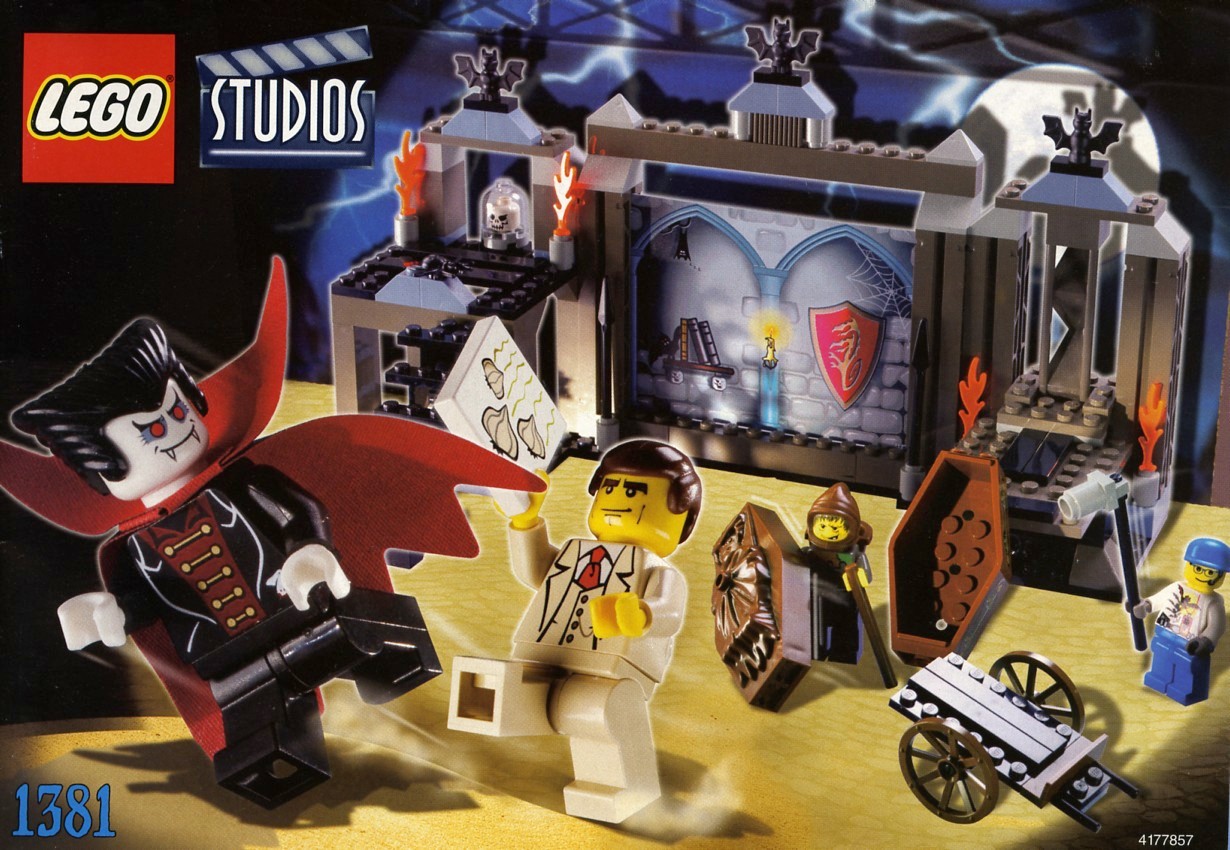
Lego’s first foray into horror was couched in artifice. While stalwarts like Castle and Pirates had always had their spooky elements (glow-in-the-dark ghosts, floppy-armed skeletons), it wasn’t until 2002 that the company produced a whole subtheme focused on scary settings and monstrous beings: or rather, the depiction of scary settings and monstrous beings. Because in 2002, Lego’s way of experimenting with new possibilities was to put them into the Studios theme.

Studios was a strange transitional theme for Lego. It was one part City, depicting the workings of a movie studio as just another business in the Lego world (where every movie is directed by a minifigure who looks suspiciously like Steven Spielberg); one part tech gimmick, being based around a rudimentary stop-motion camera that kids could use to create actual movies; and one part test bed for future standalone theme concepts.

In 1999 Lego had licensed Star Wars, but it was unclear how much licensing contemporary films would become a core part of their business going forward, so some early-2000s properties like Jurassic Park III and Spider-Man didn’t become full themes in and of themselves, but instead got folded into Studios. And to round out the lineup of films on the Lego Studios slate, they created some knockoff Universal Monsters movies.

By 2003, it was clear that licensed Lego themes were here to stay, and there was no place for Studios’ half-measures in the lineup anymore. While some original themes did continue to have scary enemies (and skeletons were of course ever-present), Lego wouldn’t return to any sort of classic monster motif until 2011.