
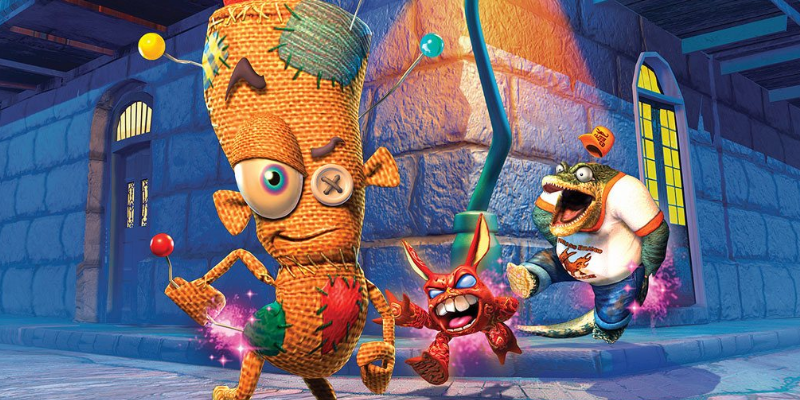
Hello, Happy Halloween, and welcome back after…three years… to Mid-Aughts Meltdown, my ongoing series on video game history! Specifically I, your loyal hostess Lovely Lily Bones, discuss its ugly adolescence, morose mediocrities, ostentatious obscurities, the forgotten and maligned (trademark of my dear friend Wolfman Jew!) from the 2000s.
What are we tackling today? An early 2000s Xbox-exclusive 3D platformer from my childhood, just like the game that started it all here, Blinx. To my great relief, and presumably yours, this has proven itself across two* 2023 replays that it’s much better than Blinx. It’s the very Halloween-appropriate Voodoo Vince. It’s Nail Time!

*One playthrough for notes and screenshots, and one to leisurely enjoy with my girlfriend while also securing the best Achievement in the game.
The Game
Like so many others discussed in this series, this was a game my family bought on the cheap for me and my mother and sometimes my older brother to play together on our family Xbox. Despite the best efforts from all three of us, we never quite beat the final boss, but we all loved the game by the end nonetheless.
For this article I replayed the game on my Xbox Series X as Voodoo Vince Remastered, a 2017 HD 60fps native Xbox One port produced in a new engine. The original game engine used custom code impossible to emulate easily, completely blocking off Backwards Compatibility support on both Xbox 360 and Xbox One as avenues to keep the game available, necessitating a proper rerelease produced with the help of the ID@Xbox program.
Voodoo Vince is very much an early 2000s 3D platformer, with its protagonist with (mercifully inoffensive) Attitude TM flanked by a somewhat wonky camera and floaty jump as he explores open semi nonlinear spaces. However, it does heavily emphasize puzzles and designing game progress directly around them instead of collectible rewards. There are collectibles but they’re distinctly secondary and largely optional; the closest equivalent to Mario’s star, Banjo’s Jiggies, Jak’s power cells, are the Voodoo Powers collected at the end of major sequences. The game’s core gimmick is that as the third best Voodoo doll around, Vince is immune to traditional forms of damage and redirects it onto his opponents, susceptible only to dark magics that surpass his voodoo. This fuels a puzzle-setpiece design ethos which defines the majority of the game across its six worlds and couple dozen levels.
It’s that solidly unique consistent gameplay ethos, and the dedication to Louisiana themed setting and atmosphere, that gives the game its strong character. Louisiana is such a specific and unique setting for video games to which the game is 110% fully committed and deeply affectionate. As a girl who grew up visiting and loving New Orleans with all her heart, this was always the first selling point, and I’m happy to report that even on its 20th anniversary, it really lives up to the promise. The French Quarter, the above-ground graveyards, the ornate manors, and the sweltering bayous are all signature parts of Louisiana and New Orleans culture and they make up four of the six main worlds. The least thematically apt world still has a great bit of wordplay in its title, Roachfort. The soundtrack is positively sumptuous: fully orchestrated live years before Mario Galaxy, largely composed and arranged by Steve Kirk and performed by a full brass band in a variety of New Orleans jazz styles, including big band, second line, and Creole zydeco. This game can’t compete with fellow first party title Psychonauts in storytelling, but it absolutely can in world and sheer vibes.
That said, let’s talk about the story for just a second. The prospect of a 2000s platformer tackling the subject of voodoo is pretty naturally concerning given that it’s a very real widely practiced indigenous religion with a very poor history of pop cultural representation in the West. While there’s still definitely some of the popular fantastical caricaturing elements here, the game handily rises above the low expectations its title and time of release invites. Title character Vince belongs to one Madame Charmaine, who is wise, responsible with her powerful Zombie Dust, where all the actual magic is, and entirely benevolent. Meanwhile, her nemesis is white middle school dropout con artist Kosmo the Inscrutable, who’s desperate to appropriate her culture and magic for selfish ends, namely the success of his podunk circus and final game world the Carnival De Prave. Kosmo abducts her and mutates a relatively grounded setting by mishandling the aforementioned magic macguffin. So yeah, that’s…actually pretty refreshingly respectful compared to just how stigmatized and caricatured voodoo often is, and that kinda balances out how stale Vince’s snark can be.
Now back to the game. So, Vince has a classic platformer jump and double jump which actually feel pretty good, and in a very generous and clever addition to help with the more precise platforming, he has a gentle indefinite hover to adjust positioning and momentum before he lands. His ground pound is actually a downward headbutt, which doesn’t have quite enough weight to it but is still at least appreciably unique. There’s a stationary first person camera like Mario 64, with Vince holding out his one eye. Lastly, in order to charge up his voodoo powers, he needs to conventionally defeat and harvest the basic dark magic enemies populating levels, so he has a punch just like Mario used to have, and a spin attack just like Crash Bandicoot. The spin attack can also add distance mid-jump. When the voodoo meter is full, pull both triggers at once to activate one of 33 random powers, amusing cutscenes with an insta kill area of effect for basic monsters. A couple favorites of mine are the Angry God, a giant sandaled foot stomping Vince flat, and the William Tell.

There’s enough different voodoo puzzle setpieces that I truly can’t describe them all, so rest assured that the game digs rightfully deep into its core mechanic across its runtime. Just in the first world, there’s a spectacular bit of time management which crosses Majora’s Mask and a point and click adventure game, and a part where Vince lights his own burlap on fire, runs down a lengthy New Orleans alleyway, keeps it lit by relighting natural gas pipes along the way, and finally arrives to blow up some surly gas pumps. Setting Vince aflame is also nicely iterated upon in World 4 when he clears out monster nests from the manor with candelabras and explosives all spaced out from each other.
The boss fights are all especially devilishly clever standouts. Open the natural history museum’s roof to get struck by lightning and zap the T Rex fossil back into its grave. Pilot a trusty rodent right into falling debris to crush a nasty graveyard statue. Bumrush across a miniature town in time to be crushed by colliding toy trains and damage the psychotic Dolly. Tear yourself up in windmills to blow a monster hurricane away. And then the enormous final boss the KosmoBot has its own final platforming gauntlet built on and in it, in a Shadow of the Colossus esque setup. It’s just some really good stuff.

There’s also more core platforming elements I like too, like the grappling hook voodoo doll needles that worlds 4-6 use aplenty, swinging from point to point. Those just feel great. But not quite everything succeeds here. Voodoo Vince is maybe a bit short and easy playing it now as an adult with much better reflexes than I had as a kid. The game also follows that Rare-style classic 3D design instinct of that era: a 3D platformer can’t just be that, it needs to keep things fresh with minigames and vehicle sections, from a little biplane, to a fanboat or a shrimp submarine in the Bayou, and even a bumper car in the first phase of the final boss. They aren’t all equally frustrating. Winning the fanboat race is pretty satisfying, while finally getting the biplane out of those narrow Roachfort tunnels felt like I’d just escaped a torture chamber. But when the core mechanic felt like it still had gas in the tank, it makes these sequences feel just unnecessary.
But let’s not dwell on the few negatives here. Let’s wrap up this section with a deep dive on that aforementioned French Quarter Square sequence. So, this bustling city square has an obligatory jazz club, a movie theater (“Two Kung Fu movies for the price of three!”), a pawn shop, a costume contest, a burlesque show, and all importantly, a clock tower. Each of these enterprises is open at a different time throughout the full 24 hour day and night cycle. At the square’s center is a horse statue for whom Vince need to find an apple. Once the horse is fed and happy, it’ll kick him instantly up to the top of the clock tower as many times as you like, though he can platform-climb up the clock tower too. Manually adjusting the clock changes the time and opens the different businesses. But using costume contest earnings to buy the trumpet and play for Bones McGurty the Jazzman and gatekeeper isn’t enough. Vince needs to attend the jazz club too to be actually able to play well. The kung fu movies and burlesque club are there purely for their own fun. It’s all a genuinely masterful delight of a setpiece.
Lastly, despite the fact that my family never did beat even the first phase of the final boss back in the day, I can confirm now with firsthand experience that this similarly long and elaborate platforming boss is…still a lot easier than the Meat Circus, mercifully. Even though it brought back that damn biplane.
The History
Clayton Kauzlaric’s career in games began at the Redmond, Washington branch of Squaresoft, the publisher’s first stab at Westward expansion. Once Square partnered with Sony on the upcoming PlayStation, Squaresoft Redmond was closed in favor of a California office. Ron Gilbert’s Humongous Entertainment hired Kauzlaric among many others of those newly out of work devs from Square to found a new subsidiary team which Kauzlaric created the logo for, Cavedog Entertainment. Cavedog’s first and foremost project was the acclaimed 1997 real time strategy game Total Annihilation, after which that game’s director Chris Taylor left, development sadly floundered, the team was hit hard by the financial difficulties of parent company GT Interactive, and the studio shut down right at the start of the new millennium. Cavedog’s closure in 2000 spurred Clayton Kauzlaric to found his own development studio, Beep Industries, where a single initial character sketch (pictured below), combined with the experience of visiting New Orleans for the first time in the mid-90s and falling in love just as I did, quickly inspired his vision of Vince the Voodoo Doll the 3D platformer.

Concepting the game was well underway with a small team who had never worked on a 3D platformer, but were passionate about their ideas. They spent the better part of the next year pitching it to various publishers, until a newly produced short gameplay demo finally won Microsoft over to sign Beep on in 2001, after saying no on two separate previous occasions. We know from previous articles that this was one of several 3D platformer Microsoft signed on as exclusives in short succession at that time, between Blinx, Psychonauts, the Rare catalog, and future subject Tork. The demo shows a different combat style from what I described above, where a floating cursor would be used to target enemies while items like a mallet are acquired and slowly, manually used to deploy Voodoo damage, but once full production began this was quickly deemed unsatisfying and replaced with the final system. Another early major change was that Vince originally started as a silent protagonist until the devs decided that an active personality and more direct interactions with characters would help audiences connect with him, leading to Ken Boynton cast in the part.

As they moved on from Voodoo Vince’s modest sales performance, Beep Industries became Beep Games and moved back to the PC market and a smaller production scale, quickly putting out five PC-only indie games in the mid-2000s. Those were Word Spiral, Realms of Gold, Four Houses, Zodiac, and Flying Leo. Clayton Kauzlaric continued to steer the ship at Beep, but he also hopped around to collaborate with old Cavedog colleagues like Chris Taylor and Ron Gilbert, and he was hired for browser, mobile, and Kinect development by Microsoft, continuing another old partnership. He and Gilbert co-created the comedic XBLA action-RPG series DeathSpank at HotHead Games before he brought Gilbert over to Beep to make two mobile games together in the early 2010s. Finally, in 2015, Microsoft promoted Clayton Kauzlaric to Creative Director for Xbox Game Studios publishing, where he still is today! They gave tremendous well-earned influence to a long-time scrappy, hardworking indie dev, with which he got Voodoo Vince Remastered greenlit to be developed by the old team at Beep Games.
There’s not anymore story left to tell by this point, but I am delighted to report that during my time writing this, I discovered a Facebook page run by some of the actual Beep Games folks as they share behind the scenes tidbits and materials from the game. I’m very lucky to have such a strong source for this piece and to see the creators themselves continuing to pay tribute and express pride in this game just like I’ve tried to pay good tribute today to a game I’ve loved for almost 20 years.

I’m happy to confirm additional Mid-Aughts Meltdown entries are already in development to keep this a regular series once again, from a Midway Games historical obituary a la The End of Acclaim, to some prominent licensed games of yesteryear. Please look forward to it!
I took a lot of screenshots from my Xbox that ultimately didn’t find a place in the article, so look forward to some highlights in the comments!
A whole lot of time and effort goes into making my work here possible. Please show your support however you can to help keep this going, whether that means sharing these articles wherever and to whomever there might be interest, or for those able to, donating to my Patreon dedicated specifically to these writings, which is linked here: https://www.patreon.com/lilytina
Thank you to Marcus TAC, Katie, Brakeman, Jarathen, Sloot, Ninjaneer, Prestidigitis, Frosst, AJ, Nemrex, Stasia, Belladonna, Suoly, Professor, Alanna, Dashboard, Monsoon, CMC, and everyone else among them for your personal and financial support of this project. Thank you everyone for your reading!
You must be logged in to post a comment.