


The fundamental rule of improv is “Yes, and.” In order for an improvised story to be successful, the players have to build upon the work of one another to make a story that is cohesive and moving forward.
The Star Wars Sequel Trilogy is set up like improv. Two (originally three) writer/directors performed a pretty delicate ballet of creating a cohesive story despite different ideas of where Star Wars should go. But whereas improv asks the players to say “yes, and”, JJ Abrams and Rian Johnson took a different approach, instead responding to each other with “no.” The result was a weird cultural flashpoint that still draws conversation to this day.
My relationship with Star Wars has ping-ponged back and forth between obsession and casual enjoyment. As a kid, I was all in on the movies and the EU. As the prequels came out, I drifted away, with moments of my love for the fandom being reignited. I saw each of the sequel movies of their release dates, and met most of them with marked indifference. I’ve reconnected with The Force Awakens and Last Jedi multiple times, with varying opinions each time. The Rise of Skywalker I think I only watched a second time, to confirm that no, I did not enjoy the movies.
But here in 2025 I decided to take another stab at the sequel trilogy and to try and watch them as a complete whole to understand where they succeeded, and where they failed. And honestly, I was surprised by my takeaways!
You probably don’t need me to recap the movies or their place in the cultural zeitgeist. The Force Awakens debuted to tremendous financial success and generally positive reviews, though tinged with “This is just a rehash of A New Hope.” The Last Jedi became a focal point in the culture wars of the 2010s, drawing criticism and praise for the directions it took the franchise and characters. The Rise of Skywalker succeeded in uniting the fandom once again, with Last Jedi lovers and alike overwhelmingly saying “Wow, that was awful.”
Abrams and Johnson approached Star Wars in different ways. Abrams aped not just the story, but also the iconography of the original trilogy. You’ll find all your favorite things here: the Millenium Falcon, X-Wings, TIE Fighters, and Anakin Skywalker’s lightsaber. He couches all of this in a series of mystery boxes: Who is Rey? Who is Snoke? Why did Luke disappear? And then, as he does, he leaves those questions for others to answer.
Rian Johnson was given that task, and answers them in ways that soured many people: Rey is no one of consequence, an orphan whose parents gambled her away for drinking money. Snoke is dispatched by Kylo Ren and any grand plans he had do not matter. And Luke ran away because he failed as a Jedi teacher and failed his sister, his brother-in-law, and his nephew in one careless moment.
Colin Treverrow was originally slated to conclude the story, but in the shuffle of reactions to The Last Jedi, Carrie Fisher’s unfortunate passing, and various executive decisions, JJ Abrams was brought in to conclude the trilogy. In response to Johnson’s choices, Abrams would once again complicate things: Who is Rey? Someone of consequence, actually: a Palpatine. Who is Snoke? Also Palpatine (sort of).
The result is a story in which the seams are very apparent. Rather than stories building upon each other into a natural conclusion, you have multiple writers coming in and saying “no, actually” and making a story that feels incohesive. In turn, the constant swerves of the story makes it harder to invest in the stakes. And that incohesion is abetted by two other major problems with the trilogy: The lack of worldbuilding and the failure of the Original Trilogy’s rebellion.
The Andor Problem
In May 2025, it’s hard to talk about these movies without talking about Andor. And while a whole essay could be written comparing the writing of Andor to that of the sequel trilogy, what stood out to me when comparing the two of them is how Andor makes the failure of the New Republic even more frustrating.
Andor is a story about the rebellion: the synthesis of disparate cells into a unified whole, the complicated decisions that have to be made in the name of resisting fascism, and the impossible choices and major sacrifices that were made to defeat the Empire. It’s an incredible, moving, difficult watch. It adds an extra layer to the struggle of the heroes of the Original Trilogy, and alongside Rogue One, Andor shows extra messy layers of the fight against the Empire.
The Sequel Trilogy is forced to create the story of “What happens next?” After Luke, Han, Leia, and of course, Hero of the Franchise R2-D2 destroyed the second Death Star and defeated the Emperor, the sequels pick up the story 30 years later to show what happened to the galaxy in the wake of the Empire’s defeat. Unfortunately, the answer “All of that struggle and sacrifice was unable to create lasting change.” And that’s something that’s difficult to stomach.
Creating a sequel is hard, particularly a sequel to something as beloved as the Star Wars trilogy (even taking into account the mixed reception of the prequels). Those movies, and more importantly, those characters, are significant to a generation. Does a sequel pick up from a happily ever after and show a new threat rising that disrupts our heroes’ happy lives? Or does it pick up showing the ways our heroes failed, and necessitating a new generation step up to create a better world?
The sequels take the latter approach. 30 years after Return of the Jedi, the fledgling New Republic is feckless, necessitating Leia to break away and lead a Resistance against the First Order. The Force Awakens provides very little context beyond that, perhaps spooked by the reception to the politics of the prequel trilogy. Why is the Republic so weak that a separate group was needed to fight the First Order? Is the First Order a small but powerful movement or a much larger, more serious threat? The sequels are not interested in answering that question, and even Disney’s expanded universe has yet to fully fill in those gaps. In the aftermath of all of this, Han and Leia have split up, Luke Skywalker has disappeared entirely, Darth Vader’s sacrifice and restoration of balance didn’t actually mean anything, and Hero of the Franchise R2-D2 went to sleep for some reason. Our heroes failed and didn’t get their happily ever after.
That’s not to say that subverting a happy ending is not a valid choice. A powerful story can be built on the back of it. But the lack of exploration into how the galaxy arrived at its present muddies an already difficult reality to grapple with. Not only did our heroes fail, it’s not entirely clear why they failed. We just have to roll along with it. Han’s a smuggler again. Luke has abandoned his friends and everyone he loves. The sacrifices of Cassian Andor, Mon Mothma, and the Rebel Alliance led to a New Republic that collapsed quickly and completely.
When the prequel trilogy came out, it recontextualized the story of Star Wars. Whereas the Original Trilogy could be cast as the story of Luke Skywalker, the prequels instead turned Episodes I-VI into the story of Anakin Skywalker. We see his rise, fall, and ultimate redemption into the person who brings balance to the Force. But the sequels manage to undo that as well. Yes, Vader defeated Palpatine, but also… he didn’t? So the Sith and Dark Side were not so much defeated as inconvenienced for 30 years until he’s defeated for real this time.
This is a choice that maybe could have worked. The sequels could have recontextualized the story of Star Wars to be the story of the rise and final downfall of Palpatine, and that might have been an interesting hook. Abrams is uninterested in that, though. There’s no real justification for why he came back, or even any clarity on his plan or how it fits into his plans through the Prequel and Original Trilogy. He’s reintroduced with the line “Somehow, Palpatine has returned” and that’s that.
Somehow, That Asshole Returned
The fascists are defeated. Democracy is restored, promising to be stronger than ever before. Yet in short order, we are forced to reckon with the idea that fascism isn’t that easy to defeat, that there are so many barriers to justice, and somehow, even though we thought an asshole leader might be gone forever – he’s back, the whole thing manages to be even stupider than before.
I am, of course, describing American politics in 2025. That is the other half of the experience of watching the sequels in 2025. These movies capture with surprising accuracy our current political landscape. America defeated Trump, but a weak response from the Democrats contributed (alongside myriad systemic problems) to Trump’s return, and at times it feels more hopeless than ever.
Political allegory has been a part of the Star Wars experience from the beginning. The grunt soldiers of the Empire are literally called stormtroopers. In Episode III, Anakin parrots George W. Bush in saying “If you’re not with me, you’re my enemy.” Lucas was not afraid to interject politics into his works, and whether deliberately or not, Abrams did the same (Johnson was much more clear and intentional about his use of politics in The Last Jedi).
It’s frustrating seeing the heroes of the rebellion fail. But it also feels all the more real now than it did in 2015 upon The Force Awakens’ release and even 2019 upon the trilogy’s conclusion. Sometimes progress is undone and we take steps back on the path to a brighter future. Does that make the sequels any better in retrospect? No. In fact, it probably makes it harder. In these stressful political times, I don’t want my media to be a mirror of the current political reality. And the muddled worldbuilding of the sequels doesn’t bring that mirror into better focus. But it’s hard not to see Trump’s second term in Palpatine’s return, and that is probably the most unexpected takeaway in rewatching these movies – and it does bring with it the spark of hope that yes, he can be defeated. Yes, the people can come together and say that they’ve had enough. And even yes – those who were allied with him might actually find redemption and work alongside the heroes to bring him down once and for all.
Bright Spots
Taken as a whole, I don’t think the Sequel Trilogy works. As a complete whole, it doesn’t tell a cohesive story. But there are some real strengths to the films, and I would be remiss if I didn’t highlight them.
These movies are led by fantastic actors. Daisy Ridley, John Boyega, Oscar Isaac, and Adam Driver do great work, supported by performances by other great actors: Kelly Marie Tran, Domhnall Gleeson, Laura Dern, Keri Russell, Gwendoline Christie, and more (plus Star Wars greats Mark Hamill, Harrison Ford, Carrie Fisher, Billie Dee Williams, and Anthony Daniels). In particular, the main trio of heroes have great chemistry. A highlight of The Rise of Skywalker is that the three of them are put together for the first time, and they’re able to bounce off of each other and feel like three legitimate friends who can support but also infuriate one another in the way friends do. I think The Force Awakens would have been stronger if it put Poe with Rey and Finn during the movies’ first acts and gave more opportunity for that chemistry to shine.
Adam Driver makes Kylo Ren into a genuinely fascinating character, at once terrifying and petulant. His interactions with Daisy Ridley also have strong chemistry. While I still find Kylo’s redemption to be a frustrating choice narratively, Driver sells that redemption (helped by a genuinely touching reappearance by Harrison Ford) and changes his mannerisms as Ben Solo in a way that makes you see how he could be the son of Han. It’s genuinely cool to see!
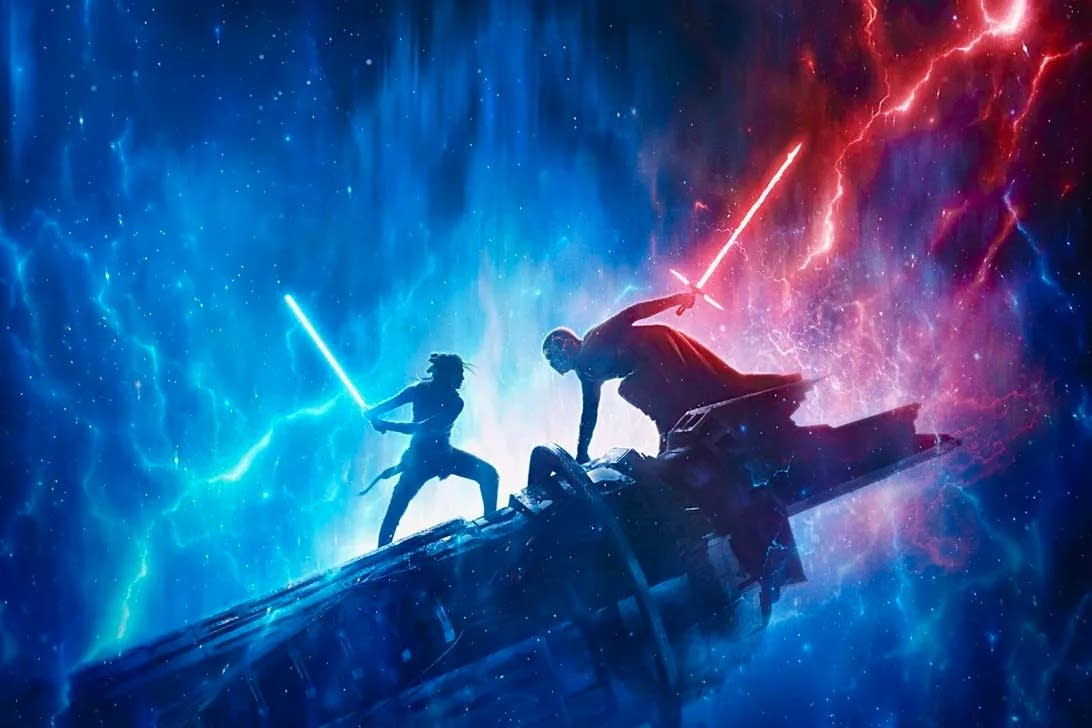
These films are also gorgeous. JJ Abrams and Rian Johnson have different stylistic choices, but both have good eyes for Star Wars. All three movies have beautiful moments: Rey’s introduction scavenging the wreck of Imperial ships on Jakku, Rey and Kylo’s battle on snowy Ilum, Holdo’s lightspeed move to shatter the First Order flagships, the white and red of Krait, Kylo and Ren battling back and forth between their respective environments, and their duel in the remnants of the Death Star. The scenery, the choreography, the lights and lasers, all of it feels like an evolution and extension of Star Wars imagery. I only wish it had been bolstered by new ship designs to complete that evolution.
A highlight of The Rise of Skywalker is that C-3PO is given a chance to shine. As the character (and actor) who has been in all nine episodes, and one of our viewpoint characters of the Original Trilogy, it’s great seeing him given a spotlight. The moment when Rey says “You know the odds better than anyone” feels like a culmination of everything his character has done, moving from comedic sidepiece to central part of the plot. However, that praise is tempered: 3PO’s pivotal involvement in the plot and sacrifice (such as it is) is immediately undercut by him quickly realizing another option right before his memory is erased, and then undercut once again by R2-D2 just… restoring his memory. While the translation part of the plot was a weird narrative MacGuffin, I did appreciate how it let Anthony Daniels have some great lines in his likely final performance.
And finally, I would be remiss if I didn’t spend a little time on the arc of Luke. Perhaps the most controversial aspect of the sequels is Luke’s story. Johnson receives much of the blame for this because it’s explored in The Last Jedi, but ultimately he is forced to answer a problem that Abrams lay down: Why would Luke Skywalker, who abandoned his Jedi training with Yoda to help his friends, who risked everything to try to redeem his father, abandon the galaxy to be taken down by the First Order?
The idea that Luke failed is a difficult one, as are all the choices involving the failure of the rebellion. But what I think is beautiful about The Last Jedi is how instead of tearing down the legend of Luke Skywalker, it’s about embracing it: Luke has lost his belief in himself due to his greatest failure, a singular moment of weakness. But he comes to realize that we must grow from failure. Kylo Ren says we should kill the past. Yoda instead says we should grow beyond it – learn from the past and pass those lessons from failure on. Luke proceeds to do so and single-handedly faces down the First Order in order to buy time for the final remnants of the Resistance to escape. And he does all of this without fighting or killing a single person, merely projecting himself across space and baiting Kylo into trying to kill him. That moment becomes “the spark that will light the fire that will burn the First Order down,” and we see that fire spreading in The Last Jedi’s closing scene of kids excitedly sharing the story of Luke’s heroics on Crait. It’s frustrating that this particular aspect of The Last Jedi was not built upon in The Rise of Skywalker. Instead, it’s Lando who rallies the entire galaxy to the cause when Luke and Leia could not.
Taken as a whole, it’s hard to say that the Sequel Trilogy is good, or even tells a good story. Even as someone who enjoys The Last Jedi, it’s still a piece of a frustrating whole. The Force Awakens is pretty but uninspired, and The Rise of Skywalker is a narrative mess. All of that adds up to a frustrating experience bolstered by great performances, beautiful cinematography, and a nagging reminder that sometimes our heroes fail – but the next generation can still learn from our failures and create a better future. And maybe that’s the story 2025 deserves.
Second Look is opening up slots of the rest of the year! We’ll be moving to a new day, but the same principle remains: an opportunity for Avocados to revisit something and see if their perspective has changed. A formal post will go up next week, but in the meantime, feel free to sign up to take a second look at a piece of pop culture.