


Throughout the 19th Century, Spain’s fortunes precipitously plummeted from the world’s largest empire to a second-rate European power. After enduring occupation by Napoleon, the loss of its Latin American colonies and a series of internecine wars, the Spanish lost the remainder of their empire in a humiliating defeat to the United States in 1898. Seeking to save face, Spain turned, like most of Europe’s powers, to Africa for a new empire. The problem is that the “Scramble for Africa” divided most of the continent already, and Spain could only lay claim to small strips of the North African coast in present-day Morocco. This led in turn to the Rif War, a disastrous conflict that catastrophically impacted Spanish politics, much as Algeria would later for France.

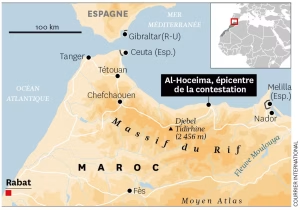
Since the Reconquista, Spain had claimed a foothold in the region, including the port cities of Melilla and Cetuan. As their New World empire waned, Madrid joined the scramble for North Africa, with Morocco retaining a precarious independence amidst the machinations of England, France and Germany. Spain moved from their coastal enclaves into the Rif Mountains to exploit their rich mineral wealth (deposits of iron, lead and silver), which offended the proud Berber peoples living there. A series of skirmishes led to ambushes of miners and railroad workers, and the defeat of a Spanish expeditionary force in 1909. The rebellion was crushed with heavy losses on both sides, while also triggering unrest at home; calls for conscription led to the so-called Tragic Week, a series of riots and protests focused on Catalonia. Both set an unfortunate precedent.
After Morocco became a French protectorate in 1912, Spain received a strip of land along the Mediterranean in compensation (but not Tangier, which remained under international control). The new protectorate proved a poisoned chalice; to guard the region’s mines, government offices and military bases required thousands of troops in the face of Berber and Arab resistance. Unfortunately, the Spanish Army consisted almost entirely of poorly-trained conscripts, armed with turn-of-the-century rifles so badly maintained they couldn’t shoot straight, and suffering from poor supplies, little pay and nonexistent morale (many troops willingly contracted venereal diseases and even mutilated themselves to avoid duty). Such a force proved ineffective against the region’s bandits and rebels, who had the advantage of terrain, mobility and a cause to fight for.


Like many empires on a budget, the Spanish were forced to rely on swagger and guile to maintain their power. That swagger came with Colonel (later General) Manuel Fernandez Silvestre, a dashing military officer who had survived 16 wounds in the Spanish-American War, including one that permanently crippled his arm. A man of undoubted personal courage, a picturesque appearance (including a rich Edwardian mustache and a stylish purple sash) and a fortuitous friendship with King Alfonso XIII, Silvestre also lacked either judgment or respect for his Moroccan subjects. Nor did he agree with the civilian commissioner, Damaso Berenguer, who favored a conciliatory policy towards the Riffs that respected their traditional autonomy. Sending such a man into Morocco without sufficient force to back him up was asking for trouble.
Soon after arriving in Morocco, Silvestre antagonized Mulai el-Raisuni, who led the Jebala confederation in the western Rif. In pre-colonial days Raisuni alternated between robbery and kidnapping foreign nationals to humiliate the Moroccan government; in the course of these campaigns, Raisuni rose from a common bandit to “a man of vision…with a shrewd understanding of the political situation” in his homeland, writes David S. Woolman. A picturesque figure who invariably charmed Westerners with his erudition, Muslim faith and aureate aphorisms (“Ignorance is a steep hill with perilous rocks at the bottom,” he chided travel writer Rosita Forbes for criticizing his banditry), he was alternately followed and feared by Moroccans. He maintained several palaces in Tangier, Zinat and other cities across the Rif, with an army of retainers eager to imprison, torture or murder his perceived enemies.
Silvestre was not impressed by Raisuni. Upon their first meeting, Silvestre spurned his host’s hospitality and immediately chided him for abusing his post in Tangier. When Raisuni refused to release political prisoners, Silvestre dismissed him from office, despite the warnings of Berenguer and other officials to conciliate him. Raisuni responded by declaring war on Silvestre; from his base in the Jebala, his troops descended to attack Spanish officials and troops while repeatedly repulsing attempts to dislodge him. To make additional mischief, during the First World War he entertained German diplomats and earned the ire of the French, who sent an expedition into the Rif to capture him. This only increased Raisuni’s stature, and his defiance towards the European interlopers. “I, like the sea, never leave my place,” Raisuni mocked Silvestre, “while you, the wind, are never in yours.”


Over the next eight years, Raisuni and Silvestre waged an intermittent guerrilla war. Silvestre, finding conscript troops and colonial levies unreliable, relied on the newly formed Spanish Foreign Legion against the rebels. Under the command of the flamboyant Colonel Millan Astray (dubbed “the glorious mutilated one” after losing eye, arm and leg in combat), the Legion instilled recruits with iron discipline and an ethos that “death in combat is the greatest honor.” Using ruthless counterinsurgency tactics, Astray’s Legion finally cornered Raisuni in his mountain stronghold; by May 1921, his defeat seemed imminent. The campaign instilled the Legion’s sense that Spain’s national destiny lay in Africa. “Morocco is Spanish Earth,” proclaimed Francisco Franco, a 28 year old Legion Captain, “because it has been acquired at the highest price…Spanish blood.”
But Silvestre’s victory, or near-victory in the Jebala only roused a stronger opponent. Perhaps Raisuni, only the most powerful of the Rif’s bandits and warlords, couldn’t easily be defeated; but they could contained or bought off without seriously threatening Spanish rule. In Abd el-Krim, however, Silvestre awakened an enemy who more expertly channeled the pride and resentments of Morocco’s people.
Krim, a caid (Islamic judge) from Mellila hailed from the Ait Ouriaghel tribe (its name roughly meaning “Those who do not retreat”). Krim initially collaborated with the European occupiers, even joining the government in Melilla as a teacher and translator. But Krim was radicalized during World War I; falsely accused of consorting with German agents, he was arrested and served a two year prison sentence. Upon his release, Krim and his brother Mohammed al-Said began organizing Riffian peoples against the Spanish, hoping for a broader movement than Raisuni’s regional brigands. When Silvestre’s forces advanced into the Abarran Mountains, Krim sent a message requesting that Silvestre withdraw. Silvestre mocked el-Krim as an “insolent Berber caid” who needed to be chastized, and immediately sent an army of 25,000 men into the disputed area.


Possessing “audacity, courage and the ability to size things up quickly,” el-Krim organized an army of 6,000 tribesmen armed with modern rifles and machine guns, either purchased from French gunrunners or stolen from Spanish military depots. Silvestre, whose forces heavily outnumbered the Rifs, ignored the advice of Berenguer to finish the war against Raisuni (against whom his best units were deployed) before starting another conflict. Instead, he promised the King “a victory so overwhelming that it will convince the Moors that they cannot afford the price of resistance.” Alfonso in turn ignored advice from his ministers to curb Silvestre’s advance; having a poor sense of reality, the King predicted an easy victory over primitive tribesmen. “Pay no attention to the Minister of the War, who is an imbecile,” Alfonso told Silvestre, who happily obliged.
Silvestre’s campaign soon unraveled. His advance guard pushed into the Abarran Mountains, where in early June they were ambushed and massacred by Krim’s men (helped by a company of Moroccan colonial troops that switched sides during the battle). Krim responded to the victory by issuing a call to jihad, warning that the Spanish planned to “occupy our lands…take our property and our women, and to make us abandon our religion.” Krim was unimpressed by Silvestre’s bluster, telling his brother that “the Spanish have already lost the game.” Silvestre, who remained in Melilla, vindicated his opponent by reorganizing his troops into defensive blockhouses, strung out in isolated positions across the Rif, diluting his numeric advantage and sapping the already-thin morale of his troops.


The resulting catastrophe proved shockingly thorough. On July 17th Krim’s men began attacking Silvestre’s positions. Several small blockhouses, some governed by as few as a dozen men, were overrun and the defenders slain. The Rifs faced serious resistance at the village of Igueriben, where a force of 100 Spanish soldiers held out in a hastily-prepared defensive position. After an initial repulse, the rebels resorted to siege; in the hot weather of mid-summer, the outpost quickly succumbed to the elements. Three miles from the nearest water source, the garrison resorted to drinking water from tomato tins, vinegar, ink and even “urine sweetened with sugar”; one survivor recalled that some maddened soldiers even slit their wrists with bayonets to drink their own blood. Silvestre’s pompous instruction to “honor the name of Spain [and] resist” availed them little.
Despite the General’s language, Igueriben fell on July 19th and its garrison was quickly slaughtered. Silvestre, who appeared in the town of Annual with his personal entourage, panicked. Receiving no responses to a request for reinforcements, the General held a council of war at which he “gnawed his mustache and swore mightily.” He ordered a force to recapture Igueriben, which was driven back by well-entrenched rebels armed with machine guns. After this debacle, Silvestre’s staff informed him that his army, besides being perilously overstretched, were low on ammunition and their supply lines vulnerable to attack. To the astonishment of those present, Silvestre ordered his men to abandon their posts and “retreat by surprise” towards Melilla. A baffling and impractical order in the best of circumstances, it ensured that the battle became a massacre.


On July 21st, Silvestre’s army began withdrawing from their outposts; before they could consolidate as ordered, Abd el-Krim’s men pounced. “What might under other circumstances have been an orderly withdrawal became a rout,” Woolman observes. “Soldiers threw away their rifles and ran off in all directions…Scores of them ran into the knives of Rifians waiting in ambush. Hundreds were shot down like rabbits by marksmen hidden among the rocks.” Those who could escape simply fled in a wild panic, in what Colonel Perez Ortiz described as as “human avalanche,” hoping that they could reach the fortified cities of Melilla and Tetouan before the Rifs could catch them.
Silvestre bafflingly remained at Annual, pacing the battlements of the half-constructed fort in his night shirt and watching the catastrophe unfold. One soldier recounted that the General, watching his men flee the victorious Rifs, shouted a bizarre order to “run, run, the bogeyman is coming!”; whether he was mocking their cowardice, or suffering a mental breakdown, the warning did nothing to stem the tide. Silvestre disappeared; various accounts of his death circulated, from disguising himself as a private soldier to committing suicide to being captured and personally beheaded by Abd el-Krim, who was reportedly sighted afterwards wearing the General’s purple sash.
The “human avalanche” continued, causing the Spanish outposts to “fall like dominoes.” Silvestre’s second-in-command, General Navarro, could only watch the flood of survivors who brought fresh tales of horror. The garrison at Kandusi were annihilated by rifle fire; those from Timayast fled their fortress, only to be butchered in a mountain pass. A company of soldiers at Dar Quebana surrendered, only to be hacked to death by their captors. A platoon of colonial troops at Yart el Bax killed their European officers and switched sides. Outside the town of Dar Darius, rebels dynamited a train carrying thousands of military and civilian refugees, shooting down the survivors as they crawled from the wreck.


The slaughter raged on through the first week of August. The luckiest Spanish soldiers reached the coastal cities, where they were protected by the guns of warships. A battalion of 500 men fought their way through the Riffian army towards the frontier of French Morocco. Hundreds joined Navarro at the outpost of Monte Arruit, sighted on a small hill outside Melilla; the rebels lacked the heavy equipment to carry the city, but the defenders were scarcely better. Lacking medical supplies, low on ammunition and exposed to the elements, hundreds died of thirst and exposure with little intervention from the Riffs. The commanders in Melilla, just a few miles away, took no action before the fort fell on August 9th; half the garrison was killed, while Navarro and 600 lucky soldiers were taken prisoner.
After Monte Arruit’s fall, Melilla was completely at Abd el-Krim’s mercy, with skirmishers launching sorties against its outskirts outskirts and Spanish commanders planning to evacuate. But by mid-August, the Riffian threat dissipated. Krim later explained that he decided not to press the attack to avoid foreign intervention, presumably by France, in the conflict. But there were more prosaic reasons why the offensive faltered; Melilla’s thick walls were impervious to Riffian rifles, and Krim’s army had no artillery; fresh troops, including the crack Foreign Legion, belatedly reinforced the city and made direct assault impractical. Further, el-Krim’s nonprofessional army of farmers needed to return home to tend to the fall harvest.
The final toll was grim enough. “All is lost, including honor,” Commissioner Berenguer proclaimed as he surveyed the chaos in Melilla. Silvestre’s army of 25,000 men had suffered a staggering casualty rate of 13,000 killed or captured (some sources claim as many as 19,000, including Moroccan deserters), compared to fewer than 1,000 recorded Rif casualties. A government commission investigating the affair reported not only massive incompetence but a system of graft and corruption, with well-documented reports of Spanish officers selling rifles and ammunition to their Berber enemies. Nor did King Alfonso’s reputation survive the calamity; informed of the disaster, he issued a comment – “Chicken meat is cheap” – as cryptic as it was callous.


In 1923, in the midst of the war, General Miguel Primo de Rivera (whose cousin commanded a cavalry regiment at Annual) seized power from the weak parliamentary regime and established a caudillo which lasted until 1930. Like Charles de Gaulle after him, de Rivera opposed the war that brought him to power; he promised a colleague that “I’ll also do what I can to leave Africa” and even sent peace feelers to Krim, offering his Berber followers regional autonomy. But Krim saw no reason to negotiate, while the “Africanists” in the Army (including Franco, who insisted to de Rivera’s face that the war must be won) threatened to oust the caudillo should he proceed with negotiations. And so the war dragged on, with Spain resorting to increasingly brutal methods of repression: aerial bombings, tanks, hostage taking and mass executions, even poison gas, to seemingly little avail.
Krim established a Rif Republic at the city of Ajdir, serving as its figurehead and military strategist while delegating day-to-day governance to his brother. While most tribal leaders joined his rebellion, a few were recalcitrant; one was the ornery, ever-defiant Raisuni, who unwisely formed an alliance with Spain in hopes of asserting his own authority over the upstart Krim. In January 1925, after several failed negotiations, Krim’s Army stormed Raisuni’s stronghold at Tazroute, wiping out his bodyguard and taking the bandit chief prisoner. Obese and deathly ill, Raisuni died soon afterwards, bested by an opponent driven by nationalism rather than banditry.
Krim successfully defied the Spanish until his victories provoked an intervention by France, who feared that the revolt would spread to their own section of Morocco. A Franco-Spanish Army headed by Marshal Philippe Petain, the hero of Verdun and future President of Vichy, routed the rebels in the fall of 1925; Krim held out until May 1926, when he finally surrendered to the French Army. Krim was then exiled to Egypt; he died in 1963, living long enough to see Morocco (including the Rif, ceded in 1956 to France by Spain) regain its independence, having in the meantime become an inspiration to guerrilla leaders like Che Guevara, Ho Chi Minh and Algeria’s FLN.


De Rivera, who came to power vowing to end the war, now claimed credit for “winning” it, stoking nationalist sentiment to salve Spain’s wounded pride. But de Rivera also alienated the public by redistributing land to the country’s landowners while repressing dissent, from Catalonian nationalists to labor unions, with brute force. In 1930 a combination of mass protests, economic turmoil and distrust among the Army brass (including Africanists who never forgave his initial dovish attitude) forced Rivera to step down; soon afterwards, King Alfonso was deposed and Spain became a Republic dominated by a liberal-left coalition.
The Africanists made the tie between colonial war and reaction even more explicit. Francisco Franco, who emerged from the war a Brigadier General, despised the Republic and as Army Chief of Staff, employed the Legion to brutally suppress strikes and civil unrest in Spain. He later used the Army of Africa as the spear-tip of his revolt against the Republic, sinking the country into civil war, followed by four decades of fascism, instituting a regime far more repressive than de Rivera’s. Although Spain ceded control of Morocco to France in 1956, it clung to the Spanish Sahara until 1976, a year after Franco’s death. Ultimately, the Specter of Fascism proved more destructive to Spain than the Bogeyman of Abd el-Krim.
Source note: This account draws heavily on David S. Woolman’s Rebels in the Rif: Abd el Krim and the Rif Rebellion (1969) and Sebastian Balfour’s Deadly Embrace: Morocco and the Road to the Spanish Civil War (2002).