


Welcome back to Franchise Festival, where we explore and discuss noteworthy video game series from the last four decades. Older entries can be found here.
This week we’ll be exploring all three dimensions of Castlevania‘s latter-day home console entries (and one portable release). Castlevania‘s 2D series titles are covered in Franchise Festival #70. Cover art, unless otherwise noted, is from MobyGames. Please consider supporting that website, as its volunteers tirelessly catalog key information and art assets for an often ephemeral medium.
Though I will be citing my research throughout the article, I’d like to draw particular attention to a few major sources:
- Gametrailers – Castlevania Retrospective (video)
- The Castlevania Wiki
Background
With the SEGA Saturn and Sony PlayStation available to customers worldwide by the end of 1995, audiences were eager for 3D content. 2D platformers had dominated the past decade, since the rise of Super Mario Bros. on the Famicom / Nintendo Entertainment System (NES) in 1985, but their days were numbered once consumers recognized the new opportunities offered by a third dimension. Developers spent much of the last half of the 1990s seeking ways to adapt the genre to 3D; some successfully implemented entirely new interpretations of platforming mechanics, like Super Mario 64 (1996), while others took the conservative route of Crash Bandicoot (1996) and effectively slotted linear 2D platformer design into 3D surroundings. Some, like Konami’s Castlevania franchise, tried to do both.


Castlevania (1999)
Castlevania had spent the 1990s reinventing itself while still reminding players of why they liked it in the first place. Super Castlevania IV (1991/1992) was an enhanced remake of the series’ 1986 inaugural entry while Castlevania: Symphony of the Night (1997) boldly established a new direction heavily influenced by The Legend of Zelda: A Link to the Past (1991/1992) and Super Metroid (1994). Following the limited commercial performance of the latter, Konami seems to have decided to relegate 2D series entries to portable devices while focusing its bigger-budget home console development projects on adapting the franchise to 3D. 2D felt outdated by the end of the decade and many studios believed that the only way to retain their series’ fans was to evolve beyond two dimensions.


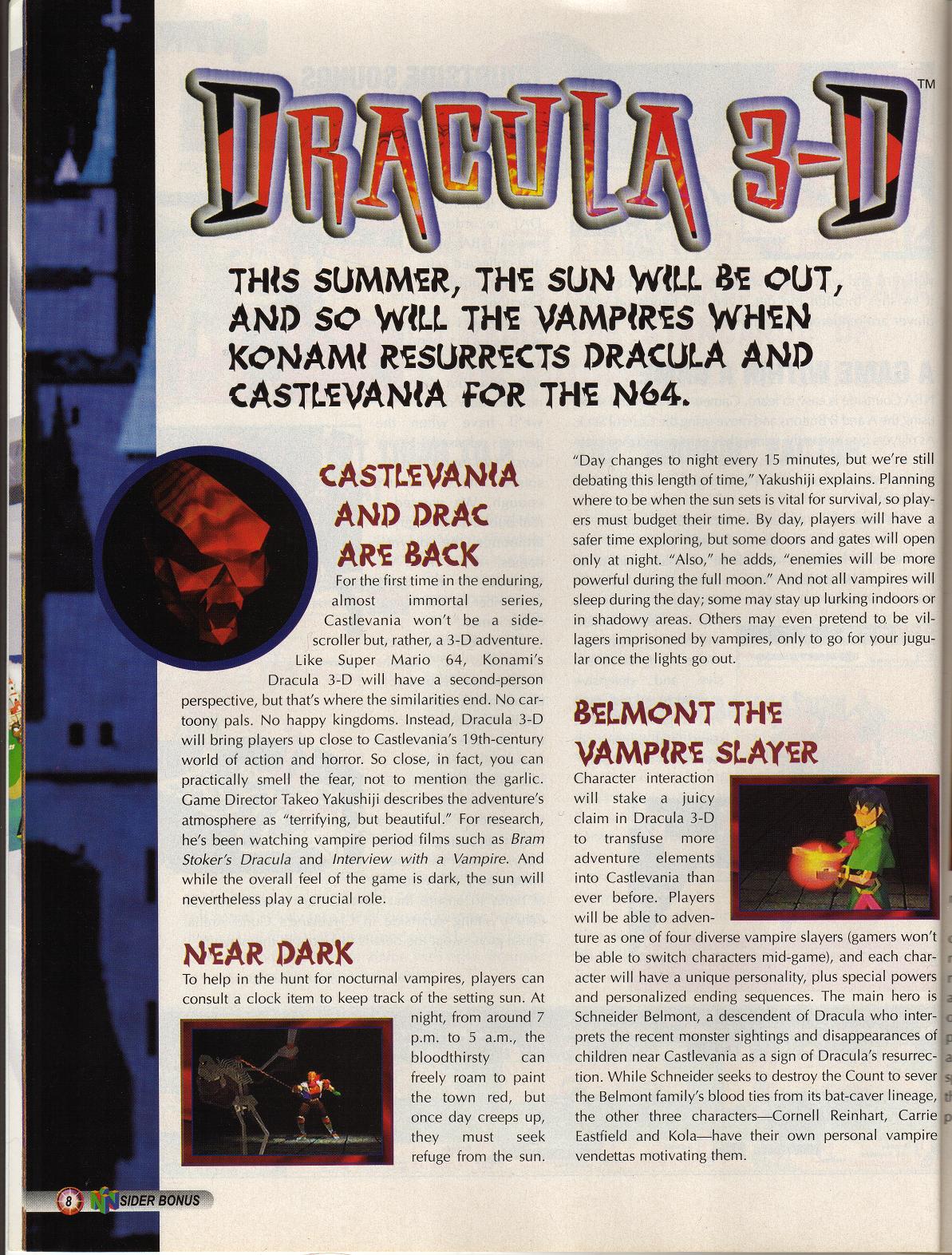
As often occurred during these tumultuous years, Konami’s ambition outstripped its reach. The studio’s Kobe division worked hard on Castlevania‘s first 3D title, internally nicknamed Dracula 3D, but needed to strip out a substantial amount of content before the game’s release. Among the most noteworthy axed elements were two playable characters, the acrobatic Cornel and chainsaw-wielding Coller.


The similarity of Cornel to Castlevania III‘s Grant Danasty is no coincidence: Dracula 3D was being more broadly designed as a successor to Castlevania III. Other evidence of this is an intersecting story structure detailed in early previews, as the player’s avatar might meet one of the other four playable characters as an ally or enemy during his or her unique campaign. This version of the game would have seen players making decisions for their chosen character which, if in conflict with the character’s personality, would have sealed off access to portions of the later game. Other influences on development at this stage included contemporary films Bram Stoker’s Dracula (1992) and Interview with a Vampire (1994).


As players would discover when they booted up the resulting Nintendo 64 game, however, much of this ambition was left on the cutting room floor. Cornel and Coller were eliminated in favor of streamlining development and getting the game done. A day/night cycle inspired by Castlevania II would remain, but intersecting character paths and plans to have the protagonist transform into a vampire did not make it into the final release.

Players instead guide either Carrie Fernandez or Reinhardt Schneider through a linear adventure across ten polygonal stages set in and around Dracula’s Castle. Carrie, who is related to Castlevania III‘s sorceress Sypha Belnades, utilizes spells and metal rings while Reinhardt wields the classic Belmont whip and daggers. Both experience a combination of combat and platforming, alternating between three camera angles designed to facilitate one of the various modes of play, and complete rudimentary puzzles that seem to have been inspired by 1996’s Resident Evil. Each receives a handful of unique stages and bosses.


Castlevania is set in 1852, as Dracula reawakens following decades of inactivity and must again be sealed away. The two heroes are drawn to his Transylvanian estate, where Carrie is forced to put down her vampirized cousin Camilla and Reinhardt reckons with his role as heir to the Belmont family. A variety of non-player characters (NPC), including vampire hunter Vincent and demon salesman Renon, offer assistance or narrative depth to the player character’s quest. The ending is determined by whether Carrie or Reinhardt completes their quest within sixteen in-game days.

While Castlevania was greeted with positive reviews upon its release, fan opinion soured quickly. Its lack of visual polish, poor performance, clumsy camera, and bland soundtrack betray a game which failed to exhibit the qualities which had defined the series since the late 1980s. Konami’s apparent last-minute rush to get the game out by early 1999 after two years in development hopelessly compromised the final product. Surprisingly, fans would soon have a second opportunity to evaluate the success of the game’s core concepts and decide whether delays would have solved its issues.


Castlevania: Legacy of Darkness (1999)
Only ten months after Castlevania‘s North American release, a second series entry was published on the Nintendo 64. It bore a new title and extensive new content but was, in essence, an expanded version of the previous game; it was even originally promoted as Castlevania: Special Edition. Konami had pumped extensive resources into the project and seems to have been determined to see its promise fulfilled.

Castlevania: Legacy of Darkness is nominally a prequel to the preceding Nintendo 64 adventure. The year is 1844 and the player can initially only control Cornell, a man with the power to transform into a powerful beast form at the expense of accrued magic jewels. Once the game’s thirteen stages are complete, the player can then take on a secondary quest to save children hidden within six repurposed environments as a pistol-wielding knight named Henry. Saving the children unlocks the ability to play through a new version of the previous game’s campaign as Reinhardt or Carrie.

Performance is more stable in Castlevania‘s second 3D outing, but the challenge presented by its unreliable camera perspective remains unresolved. Though reused assets and environments from the prior game can be enhanced through insertion of the Nintendo 64’s RAM-boosting Expansion Pak, upgrading the graphics through this means noticeably reduces the game’s speed. Legacy of Darkness is a more feature-rich game than its direct predecessor but still fails to live up to the reputation of its source material.


Castlevania: Lament of Innocence (2003)
Though critics had largely turned on Castlevania‘s first attempt at 3D gameplay following the release of Legacy of Darkness, Konami was already well into development on a sequel for the SEGA Dreamcast. Castlevania: Resurrection was planned to feature Castlevania: Legends‘ (1997) Sonia Belmont and eschew Symphony of the Night‘s RPG elements in favor of pure arcade action. Unfortunately, due to Konami’s lack of faith in the project after a year in development at their Kobe studio and the Dreamcast’s commercial failure following the release of the PlayStation 2, the project was canceled in 2000. No prototype circulates, though a pre-rendered introductory movie and a full soundtrack are still available online at the time of writing.


Koji Igarashi became Castlevania‘s series producer in 2001 and soon took over development on both 2D and 3D entries. While the former had been making use of composer Michiru Yamane and character artist Ayami Kojima since Bloodlines and Symphony of the Night, respectively, Igarashi brought these two individuals’ talents to bear on the 3D branch of the series for the first time with the PlayStation 2’s Castlevania: Lament of Innocence in 2003. After the rocky start characteristic of so many series’ transitions to 3D in the 1990s, Castlevania‘s new style was beginning to come together as development responsibilities shifted from Konami’s Kobe branch to its Tokyo division (KCET).


Igarashi originally planned to introduce his “Metroidvania” concept into a 3D space with Lament of Innocence but abandoned this approach when the resulting level design proved too confusing. He then pivoted to development of combat and puzzles. Both are confined to discrete stages, emphasizing individual challenges rather than the open exploration of Igarashi’s 2D series entries.


The player takes on the role of Leon Belmont in 1094 as he attempts to rescue his fiance Sara from a nefarious vampire named Walter Bernhard. The story takes a grim turn once Leon finds Sara, exploring the tragic origins of the Belmonts’ Vampire Killer whip. By the end of the adventure, the full background of the Belmont/Dracula feud has been revealed.


Gameplay is, as suggested above, heavily focused on individual combat encounters in and around Walter’s castle. These articulate as a series of rooms which can only be passed once Leon has defeated all opponents and/or completed a puzzle. The action is viewed from a consistent angled overhead perspective, obviating the camera issues which plagued the franchise’s Nintendo 64 entries. Environmental design, due to the lack of emphasis on exploration, sadly retains the relative blandness of the game’s 3D predecessors.

Lament of Innocence was better-received by fans and critics than Legacy of Darkness. Criticism was primarily directed towards the game’s repetitive gameplay, though its aesthetics and soundtrack were praised. While it would not constitute a turning point for players who had already concluded the series was best enjoyed from a side-scrolling perspective, Lament of Innocence had established a strong foundation from which to build a more ambitious 3D interpretation of Konami’s gothic horror property.


Castlevania: Curse of Darkness (2005)
The next home console Castlevania title was released on the PlayStation 2 and Xbox in 2005. Igarashi, Kojima, and Yamane were again leading the team, though the latter was now assisted by fellow composer Yuka Watanabe; this may account for the introduction of electric guitars to the soundtrack, altering the texture of what was previously a strings-oriented sound profile. The underlying engine is identical to that used for Lament of Innocence.

Castlevania: Curse of Darkness is set four centuries after its direct predecessor, and concerns events which chronologically follow shortly after Castlevania III: Dracula’s Curse. Though Castlevania III‘s protagonist appears as an NPC in Curse of Darkness who can only be controlled in a bonus mode after completing the main story, the player’s primary character is a series newcomer named Hector. As a first for the franchise, aside (arguably) from Alucard in Symphony of the Night, the player character is a former member of Dracula’s army: Hector was a Devil Forge Master working for Dracula before abandoning his evil ways and settling down in Eastern Europe with fiance Rosaly.


Castlevania‘s unfortunate tendency to have protagonists’ love interests killed or kidnapped to motivate their adventure raises its ugly head once again, though, and Rosaly’s demise at the hands of a group directed by rival Devil Forge Master Isaac prompts Hector to go on a vengeful crusade. As is typical in this type of story, Hector must eventually confront the question of whether his bloodlust is justified and what he will give up in exacting revenge. As ever, a host of NPCs appear throughout the quest to offer their own perspective and participate in machinations dedicated to resurrecting Dracula once more.


The narrative’s initial omission of the vampire lord has consequences on the game’s appearance. Rather than being set within Dracula’s Castle, Hector’s adventure takes him across a variety of outdoor and indoor environments throughout Europe. This offers the promise of a wider visual palette than that encountered by players in Lament of Innocence, though the rigid level design is more or less unchanged. Players are still effectively moving through a series of linear corridors rather than backtracking and unlocking new areas using skills they have acquired.


Innocent Devils, monsters which can be summoned by Hector once he has found a petrified specimen of their species somewhere in the game’s environment, serve the role of 2D series entries’ ability systems. These partner monsters augment Hector’s stats and can also assist him in Curse of Darkness‘ combo-based hack-and-slash combat. Certain Innocent Devils permit Hector to reach otherwise-inaccessible areas, though these have only limited implementation and are usually acquired shortly before they are needed. For better or worse, backtracking and rediscovering new spaces within familiar areas is rarely necessary.

Improving a handful of other issues from Lament of Innocence by expanding weapon variety and introducing a player-controlled camera would not keep the game from being panned by critics. The Innocent Devil collection mechanic is forced onto a combat system which does not justify its complexity, as even bosses are relatively straightforward. Curse of Darkness would be the last 3D Castlevania created internally by Konami, and Koji Igarashi’s future efforts would be dedicated entirely to the franchise’s significantly more successful portable 2D titles.


Castlevania: Lords of Shadow (2010)
Poor sales prompted a reevaluation of the Castlevania series’ ongoing evolution in the late 2000s. Consequently, third party developers were asked to submit proposals for the next entry in the storied series as it entered its third decade. Spanish studio MercurySteam made the successful pitch, a reimagining of the series’ original title in 3D, though cold feet among Konami executives led them to walk the project back to being a prototype for a new property. Only the direct intervention of auteur Hideo Kojima on behalf of David Cox, Konami’s in-house executive producer on the game, persuaded Konami to let the project move forward as Castlevania: Lords of Shadow.


Kojima would have ongoing involvement in the game’s development through collaboration between MercurySteam and Kojima Productions, his personal division of Konami’s internal development operation. With Kojima’s input, the remake plan was scrapped and Lords of Shadow‘s protagonist was redesigned to look less barbaric. Kojima also facilitated voice acting for the Japanese version of the game while remaining relatively hands-off.

The game that fans encountered upon its release on Xbox 360, PlayStation 3, and Windows PC in October 2010 bears only a limited resemblance to the titles which preceded it. Players take on the role of Gabriel Belmont, a holy knight in Southern Europe during the mid-11th Century. A dense plot loaded with prophecies, murdered spouses, and the scheming of Satan himself is told through lengthy, operatic cutscenes. The ending even offers an uncharacteristically impressive twist for the otherwise-straightforward franchise.

Gameplay has much in common with Sony’s God of War (2005 – 2018), though there are also shades of the contextual platforming of Naughty Dog’s Uncharted (2007 – 2017). The former informs Lords of Shadow‘s combat, which consists of combo-based battles against waves of enemies in enclosed areas using a unique chain whip called the Combat Cross. The Combat Cross can be augmented with magical skills or be supplemented through the use of the franchise’s classic sub-weapons (throwing knife, holy water, etc.). Platforming, unlike the Nintendo 64’s Castlevania or Legacy of Darkness, is dependent on finding surfaces which can be contextually navigated between rather than freely leaping from one to another; along with a fixed camera, this cuts down on the frustration commonly associated with jumping between platforms in a 3D space.

Massive bosses are among the most significant updates to the series’ visual and mechanical palette. These evoke the impressively articulated oversized bosses increasingly common within 2D Castlevania games, though the malleability of 3D perspective allows them to be much larger. Gabriel is often forced to scale them and engage in quick-time events (QTEs), a series of contextual on-screen button prompts, to bring them down.

Lords of Shadow was the series’ most commercially successful title to date in spite of it wearing the influence of contemporary 3D action-adventure franchises a bit too clearly. A rock-solid presentation produced by MercurySteam’s artists, in collaboration with composer Óscar Araujo and industry veteran Hideo Kojima, served to ground sometimes-bland combat within a suitably grand gothic world. Two poorly-received downloadable episodes failed to diminish the impression that Castlevania had finally managed to meaningfully evolve beyond its 2D origins. By leaning into the unique opportunities of 3D game design, Castlevania: Lords of Shadow established a distinct identity for the 3D offshoot of Konami’s venerable action-horror property.


Castlevania: Lords of Shadow – Mirror of Fate (2013)
Development began on the second entry in MercurySteam’s planned reboot trilogy in 2010. Producer David Cox and director Jose Luis Márquez originally set out to combine elements of its own new approach to the franchise with classic side-scrolling Castlevania designs, drawing particular inspiration from Castlevania III. The game was planned for home consoles but shifted to the portable Nintendo 3DS early in development. Prototyping for multiple consoles, including the PlayStation Vita, and a poor reception at the 2012 Electronic Entertainment Expo delayed development but did not manage to scupper Mirror of Fate.


At various points throughout the new side-scrolling adventure, players take on the role of Simon Belmont, Trevor Belmont, and Alucard as they battle Dracula decades after Lords of Shadow‘s momentous climax. Though these figures are all pulled from earlier Castlevania titles, their interpretation here is entirely new. MercurySteam was dedicated to reinventing the series’ complex mythology even while referencing its lengthy history.


Gameplay is viewed from the side, which implies a continuity with the franchise’s 2D releases. Its mechanics, however, bears more in common with its direct predecessor rather than Hitoshi Akamatsu’s NES entries or Koji Igarashi’s Game Boy Advance and DS titles. Combat is slow-paced and relies on combo attacks augmented by magic, with each individual enemy sustaining more blows than they had in any other 2D Castlevania game. Exploration is more emphasized than it had been in the 2D series’ earliest titles, but not to the degree of Igarashi’s “Metroidvania” sub-series. Role-playing game elements like character stats and equipment are likewise absent in favor of unlockable attacks.

Belying its origins as a high-definition (HD) title, Castlevania: Lords of Shadow – Mirror of Fate would subsequently be published in a visually enhanced edition on the Xbox 360 and PlayStation 3 in late 2013 and on Windows PC in early 2014. Sadly, all versions were received poorly due to their sluggish combat system and storytelling. Mirror of Fate seems to have underlined the corollary to the problem its predecessor overcame: while 3D Castlevania titles struggled when attempting to accurately translate the 2D experience, mechanics originally designed for 3D environments feel unnatural when emulated in two dimensions.


Castlevania: Lords of Shadow 2 (2014)
MercurySteam expanded its staff and began developing Lords of Shadow 2 even as it was working on Mirror of Fate. The studio had plans to leave the franchise behind after its third Castlevania installment, so Cox and director Enric Álvarez intended to fully wrap up the epic story they’d begun with 2010’s series reboot. The result, released on the Xbox 360, PlayStation 3, and Windows PC in 2014, was their most ambitious release yet.

Players step into the shoes of Dracula as he embarks on what he describes as a holy crusade. The narrative, set roughly a century after the first Lords of Shadow, heavily recontextualizes the vampire lord as a sympathetic character rather than a simplistic villain. Lords of Shadow 2 emphasizes Dracula’s internal struggle even as it dramatically expands the scope of his surroundings.

Where Lords of Shadow and Mirror of Fate had been linear quests through a series of arenas and corridors, cleverly disguised through the use of cinematic cutscenes and impressively massive boss battles, Lords of Shadow 2 instead offers a sprawling open world to explore. The prior titles’ fixed camera angles are similarly replaced with a player-controlled perspective that reflects the world’s enhanced horizontal and vertical dimensions. In addition to being able to cycle between three different weapons – a Shadow Whip functions similarly to the Combat Cross in Lords of Shadow, while a Void Sword drains enemy health and the Chaos Claws tear through enemy defenses – Dracula can also shift his form into mist, a pack of rats, or a dragon to solve puzzles and environmental obstacles.

As with Lords of Shadow, a DLC episode for Lords of Shadow 2 was published several months after the game’s initial launch; this package includes the opportunity to reprise the role of Mirror of Fate‘s Alucard in a new side story. Lords of Shadow 2 received a less positive reception than MercurySteam’s earlier home console series entry, in spite of its compelling combat mechanics and lush visual design, due to poor pacing and a bland modern city hub. Allegations of mismanagement leveled against Enric Álvarez by a former employee further soured public opinion on the game, though Álvarez and Cox disputed this account in a 2016 Eurogamer interview.

MercurySteam seems to have been unable to recapture Lords of Shadow‘s lightning in a bottle and soon moved on to other intellectual properties, as had been planned. Lords of Shadow series producer David Cox, on the other hand, resigned from Konami in the midst of the same notorious 2015 restructuring that led to Hideo Kojima’s unceremoniously exit from the studio. No subsequent 3D Castlevania titles have been released at the time of writing in late 2019.


Spinoffs
Castlevania: Judgment, a one-on-one fighting game released on the Wii in 2008, was developed by third-party studio Eighting but produced by Konami’s Koji Igarashi. Igarashi’s close management of the series’ timeline allowed him to integrate a wide variety of characters drawn from Castlevania‘s lengthy history. Simon Belmont, Trevor Belmont, Grant Danasty, Sypha Belnades, Maria Renard, Eric Lecarde, and Shanoa comprise the Warriors of the Light while Alucard, Camilla, Golem, Cornell, Death, Dracula, and Aeon make up the Warriors of the Night. While most of these characters are major protagonists or antagonists from earlier titles, two are standard series enemy types (Camilla and Golem) while one is entirely unique to this game (Aeon).


%20-%20resurrection%20e3%20preview.jpg)


The narrative is characteristic of series crossovers, with futuristic foe Galamoth – first spotted in 2D spinoff Kid Dracula (1990/2019) – attempting to bend time and destroy Dracula to effect his own sinister plot through a proxy called the Time Reaper. This offers a justification for heroes and villains drawn from distant eras to interact with one another. Gameplay is heavily reliant on the Wii’s motion controls, as combos are executed by a combination of button-presses and swings of the WiiMote controller. In a nod to series tradition, sub-weapons can be used by fighters and Dracula’s minions roam the game’s ten arenas; the latter can be slain by fighters to regain energy.

Reception to Castlevania: Judgment was negative, as it lacked much of what fans had come to enjoy in its source material. Controls were imprecise, due to inaccuracies inherent in the WiiMote’s motion capture, while jarring new character designs by Death Note manga artist Takeshi Obata undermined Castlevania’s characteristic gothic appearance. Judgement was, unfortunately, Igarashi’s final Castlevania project before he was reassigned to the studio’s Social division in 2011 and then left Konami in 2014.
Conclusion
Since the end of MercurySteam’s Lords of Shadow sub-series, no 3D Castlevania titles have been released. The only new Castlevania game of any kind published since 2014 has been Castlevania: Grimoire of Souls, a microtransaction-based multiplayer spinoff soft-launched on mobile devices in Canada with no formal announcement in September 2019; it remains unavailable in the United States at the time of writing. Konami otherwise appears to be content re-releasing the series’ 2D hits and producing tie-ins outside of the video game medium, including pachinko machines and a popular animated Netflix series. With all of the major creative personalities formerly involved in the series – including Hitoshi Akamatsu, Koji Igarashi, and David Cox – having departed Konami by 2015, the future of Castlevania remains uncertain. Perhaps some future visionary will yet be able to take the series’ disparate threads and craft some new interpretation for a future generation.
What’s your favorite 3D Castlevania game? How about your least favorite? Do you prefer fixed or player-controlled cameras in 3D action games? What would you like to see in a future 3D Castlevania game? How many legs is too many legs for a creature of the night? Let’s discuss in the comments below.
Next week we’re covering House of the Dead for SPOOOKY MONTH. Here is a brief outline of future entries (subject to change):
- #72: House of the Dead – October 18
- #73: Clock Tower – October 25
- #74: Uncharted – November 1
- #75: Sonic the Hedgehog (2D) – November 8
- #76: Sonic the Hedgehog (3D) – November 15