


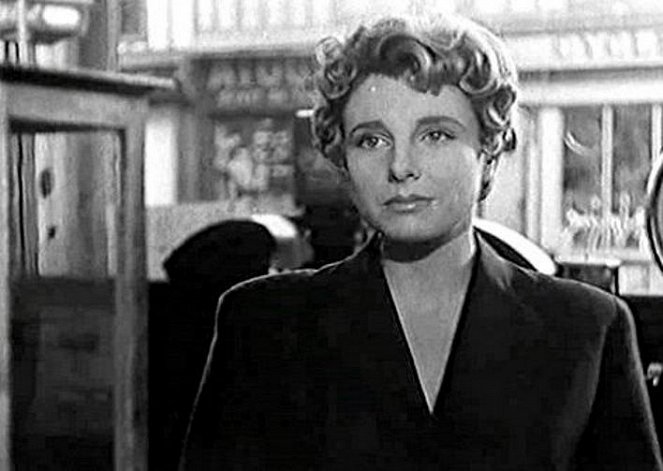
Adam est Ève (Adam is Eve) has all the trappings of a broad Hollywood farce but this 1954 film surprises by how thoughtfully and respectfully it treats it’s trans main character. This dichotomy becomes clear early on. In what seems like the intiating event, Charles Beaumont, a military man, is knocked unconscious in a boxing match and wakes up overcome with feelings of feminity. Because the movie has already established a farcical tone through scenes of the boxer’s friend and family including fiancée Claire (Anouk Ferjac) comically bantering as they listen to the boxing match on the radio, you immediately assume that the film is setting up the goofy premise that the boxer becomes trans from brain trauma but the script is more thoughtful than that. The boxer reveals that they had these feelings before the k.o. and that these feelings, along with the physical attraction they felt for the Black boxer across the ring, prevented them from putting up a defense and got them knocked out in the first place rather than the other way around. This sets the tone for the whole movie where there is a lot of witty repartie and great gags on the peripheray of the main plot but the main’s character transition from Charles to Charlotte (both played by actress Michèle Carvel though seemingly dubbed in the first half) is never treated like a punchline in and of itself.
Attempts to cure Charles’ of his growing gender uncertainty fail as the wedding planning moves along complete with a bachelor party. In French the later are known as “enterrement de vie de garcon” (boyhood’s burial) which needless to say takes on a whole other meaning in this context. In a gently comical and endearing moment, Charles coyishly approaches a sex worker only to ask her to teach him how to knit which she obliges as they spend the night together. The wedding proceeds but an unhappy Charles eventually skips out on his marriage and undergoes a two year conversion process which includes surgery. Charles becomes Charlotte and Michèle Carvel is no longer dubbed nor disguised going forward.
Gradually, Charlotte begins to rebuild ties with her former life beginning with fiercely loyal comic foil, Gaston (Jean Carmet). Gaston is undyingly supportive and acts as the bridge to Charlotte’s former life. Madame Beaumont is accepting. Monsieur Beaumont is much less so though his pushback is limited to the same kind of banal transphobic platitudes you might hear today. Claire even takes Charlotte back in. Word starts to get out making Charlotte a bit of a media sensation. An impresario offers 20 000 French Francs for a nude performance. This leads us to the film’s final set piece, the cabaret. Tension builds as Charlotte is set to appear nude in front of an audience populated by most of the principal cast. While there is some nudity in this scene curtesy of nameless caberet dancers, an 11th hour intervention ultimately keeps Charlotte clothed. That we ultimately don’t see the main character objectified is another way in which the film builds up to a zig only to zag instead.
Ultimately, Charlotte is shown to be a delightfully self-assured character who is mostly accepted by her entourage and the film is incredibly endearing whith it’s displays of verbal wit, breezy charm and most importantly trans joy. The script is from the French writer Francis Didelot adapting his own novel. He is also credited as assistant director to René Gaveau. There’s no obvious indication that these creators had personal reasons for depicting transition in such a positive light but that’s nonetheless what they did and it’s all the more compelling because it’s done without any hint of didactism.
Adam est Ève can be found on Internet Archive and on YouTube, The former upload is of better quality but neither features English language dubbing or subbing. It’s for this reason, that I pinch hit for this column’s regular host SadClown. I would like to thank them for lending me this space and introducing me to this wonderful film. You can find their reviews on The Avocado, Letterboxd and Serializd. Their podcast, Rainbow Colored Glasses, can be found here.
